
Dotcom Chronicles, Side Story 2: Code Is Due Out "Any Time Now"
In November 1992, in the third year of the Web that Berners-Lee had built at CERN, the particle physics laboratory in Switzerland, CERN’s website had a page on Ted Nelson and Xanadu, written by Berners-Lee himself. The first paragraph said that Nelson “originally invented the word ‘hypertext’ for ‘non-sequential writing’,” that his long-standing interest in it had become the Xanadu project, and that “The Xanadu Operating Company is now owned by Autodesk, but the project continues. Code is due out ‘any time now’.” The quotation marks around “any time now” are in the original. The second paragraph recommended Literary Machines, which Nelson published himself, “I have a copy of LM 90.1,” as essential reading on hypertext. A year later two sentences on the page had changed: the Xanadu Operating Company “was owned for a while by Autodesk, but later dropped. (Not clear in 1993 what is going to happen there)”1
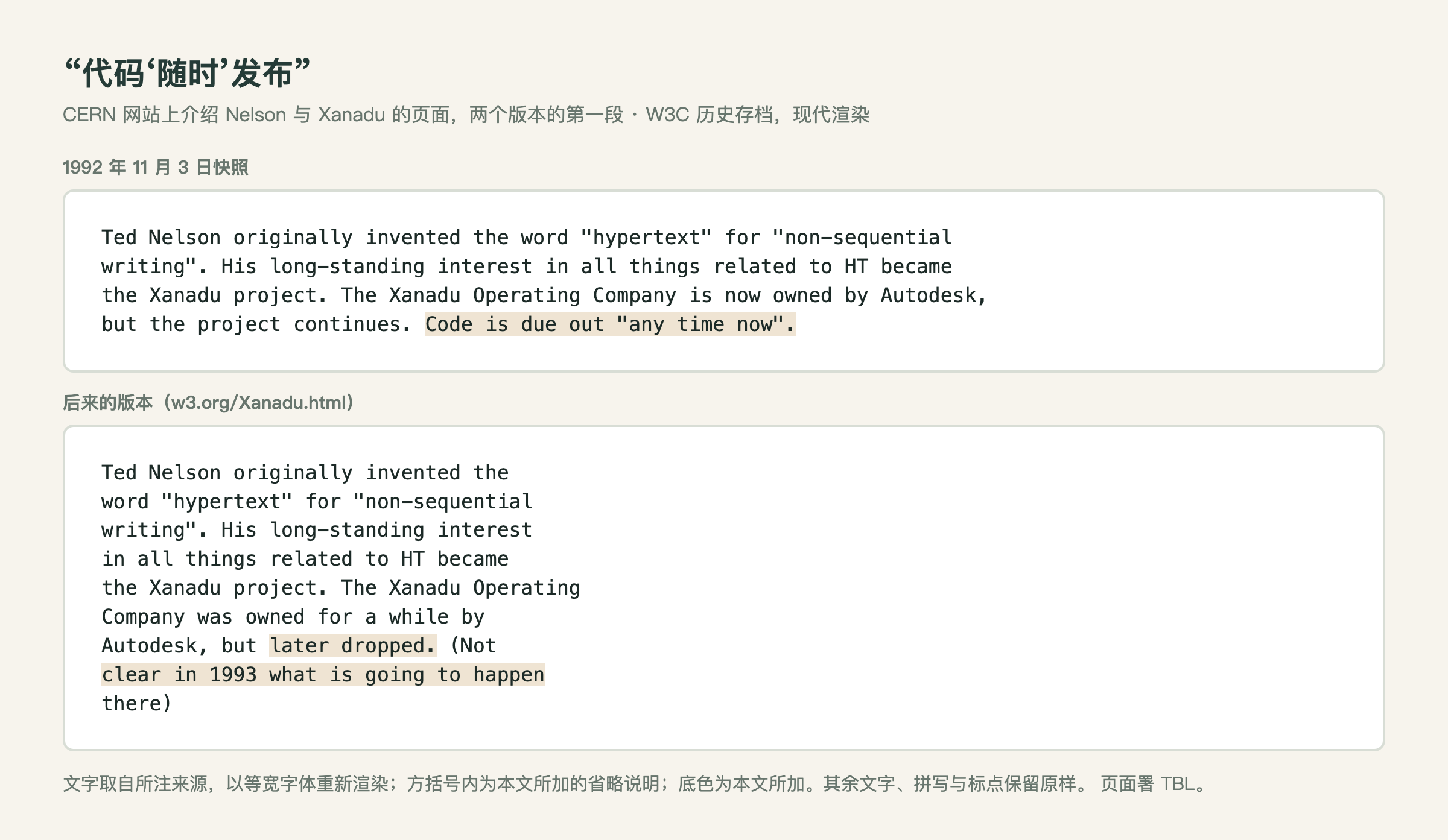
The page on Nelson and Xanadu on CERN’s website, the first paragraph of two versions. Above, the snapshot of 3 November 1992; below, the later version. Text from the W3C history archive and w3.org/Xanadu.html, re-rendered in a monospaced font, with background shading added for this article; not how it looked in a browser at the time. The page is signed TBL; quoted here as a historical excerpt.
When this series wrote about Berners-Lee, Xanadu was what the experts thought hypertext ought to look like, the design he admitted he could not build. This piece is about Xanadu itself. I should say up front that Xanadu is one of my favorite designs, so I recorded the dates below while fretting on its behalf. “Any time now” meant 18 months in 1988, the first quarter of next year in 1989, and any time in 1992; the code would take another seven years. Nor did the story end when the code came out in 1999: in 2014 it got a version you could open in a browser, and in September 2026 someone was still writing that the users Xanadu had been waiting for had finally arrived.
“Non-Sequential Writing”
By Nelson’s own account, the idea came to him in 1960, when he was a graduate student at Harvard. He had finished a philosophy degree at Swarthmore College in 1959, studied sociology at Harvard, and took his master’s in 1963. A Wired reporter later wrote that hypertext was invented during his first year at Harvard, as a term project: a “writing system” that let users store their work, change it, print it out, and compare alternate versions side by side. He never finished the code and took an incomplete for the course. The word was chosen in 1963 and published in 1965. That February the Vassar College student newspaper reported on one of his talks and printed “hyper-text,” with a hyphen, the first time the word appeared in print; the same year he read a paper at the national conference of the Association for Computing Machinery titled “A File Structure for the Complex, the Changing, and the Indeterminate.”2
The project got its name in 1967: Xanadu, from Coleridge’s “Kubla Khan.” Coleridge said he had composed a few hundred lines in a dream and had written down only the opening when someone came to see him on some trivial business; by the time the visitor left, the rest was gone, so the poem is only an opening. Thirty-two years later the Xanadu project’s chronology explained the name, and its first sentence was: “No, we did not get it from Olivia Newton-John.” That was a 1980 musical of the same name, starring her. Only after that did it get serious: they chose the name “to represent a magic place of literary memory and freedom, where nothing would be forgotten.” The chronology did not skip the other half of the poem either, noting that its tradition “also associates the name ‘Xanadu’ with memory and lost work.” When the Wired reporter later went to see Roger Gregory, Xanadu’s longtime programmer, at a company called Memex, the sign on his office door read: “S.T. Coleridge and Sons. Danger.”3
In 1974 Nelson self-published Computer Lib/Dream Machines, a book with a front cover on each side, which told ordinary people that computers were something they could use themselves. The introduction began: “Any nitwit can understand computers, and many do.” He typed the text and pasted it straight onto layout boards, took them to the printer himself, and when he picked up the books found that about a third had their pages in the wrong order, so he had the printer unbind and rebind them. After that he taught at Swarthmore for several years, teaching his own work.4
Though Xanadu was starting to earn a small reputation in academic circles, it was not until 1979 that a group of programmers gathered to work on it full time. That summer Nelson called several young people to Swarthmore, Pennsylvania; Gregory rented a house, and Mark Miller, still at Yale, was due to start his senior year in the fall. The Wired reporter wrote that they spent the summer on the porch and at blackboards, “musing over the difficulties of making hypertext code that really worked,” and that “That summer was Xanadu’s golden age.” Gregory’s own words: “The summer went a little slower than we thought.” Nelson did not like the reporter’s version, least of all the word “disciples” for these people: “I am not aware that any of them considered themselves ‘disciples;’ I certainly didn’t. We were friends.”5
In 1981 Nelson wrote the whole design into a book, again self-published, called Literary Machines. It was revised every few years, with version numbers like software, 81, 87.1, 90.1, 93.1; the copy Berners-Lee owned was 90.1. The book describes a system in which all the world’s literature goes into one repository, which he called the docuverse; every document, every byte, has a permanent address, which he called a tumbler; links are recorded at both ends, so that when a document changes or moves the links follow it and do not break; quoting someone else’s passage means embedding those bytes in your own document instead of copying them, which he called transclusion; and readers pay by how much they read, with the money divided by the byte among the authors read. He coined all of these words. In 1998 he listed his coinages on his website, among them “cybercrud,” from 1967, for the talk the computer industry uses to intimidate people. When a man coins a word for every one of his concepts, I think it is because he worries that old words will drag new things back into old understandings; his own explanation, in 1995, was that this “is not a ‘theory of language,’ it is a set of useful precepts for fast-changing conceptual environments.” These pieces interlock: links that do not break need permanent addresses; royalties by the byte need both links and addresses that do not break; none of them is a product alone, and only together are they Xanadu.6
“By 1989, It Will Be a Product”
In 1983 Gregory founded the Xanadu Operating Company to turn the 1981 design into a product. From that year there were two Xanadus: the server software that Gregory, Miller and the others were writing, and the byte-billing publishing system Nelson wanted, which was to run on that server and without it could only be rules on paper. An agreement that year, the “Silver Agreement,” gave Nelson full rights to the second in exchange for giving up any authority over the design, management and business of the first. He demanded the agreement himself; he later said it came out of “the knock-down-drag-out meeting in 1983,” held in a living room in San Antonio. I suspect that in 1983 he did not count giving up design and management as a price: the server was the programmers’ business, and what he wanted sat on top of it. In 1999 he called the agreement the thing that reduced his role “to spokesman and eventually fall guy,” but that was an account settled sixteen years later. So for the next nine years, Nelson watched most of what mattered about Xanadu from offstage.7
At the Hackers’ Conference in October 1987, John Walker, founder of Autodesk, the company behind the AutoCAD drafting program, had a talk with Gregory. On 8 April 1988 Autodesk announced it would buy 80 percent of the Xanadu Operating Company and fund development, and Nelson had the Silver Agreement written into the acquisition. At a press conference at the West Coast Computer Faire, Walker read a statement: “In 1964, Xanadu was a dream in a single mind. In 1980, it was the shared goal of a small group of brilliant technologists. By 1989, it will be a product. And by 1995 it will begin to change the world.” It would “take the Xanadu development team 18 months to field the first Xanadu system.” A press release the same day announced Nelson as an Autodesk Distinguished Fellow, working in the Sausalito office, and ended: “Ted Nelson, maverick software designer, flamboyant legend, idealistic prognosticator, eloquent generalist, and now Distinguished Fellow at Autodesk. Ted Nelson is where he belongs.” I suspect he did not mind reading it. When the reporter in 1995 left the “Distinguished” out of his title, he made a point of correcting it: “My title was Autodesk Distinguished Fellow, thanks.” The programmers were more than an hour’s drive away in Palo Alto. Two months later Walker stepped down as chairman, saying in his farewell, “We expect to ship the first commercial Xanadu system in less than 18 months.”8
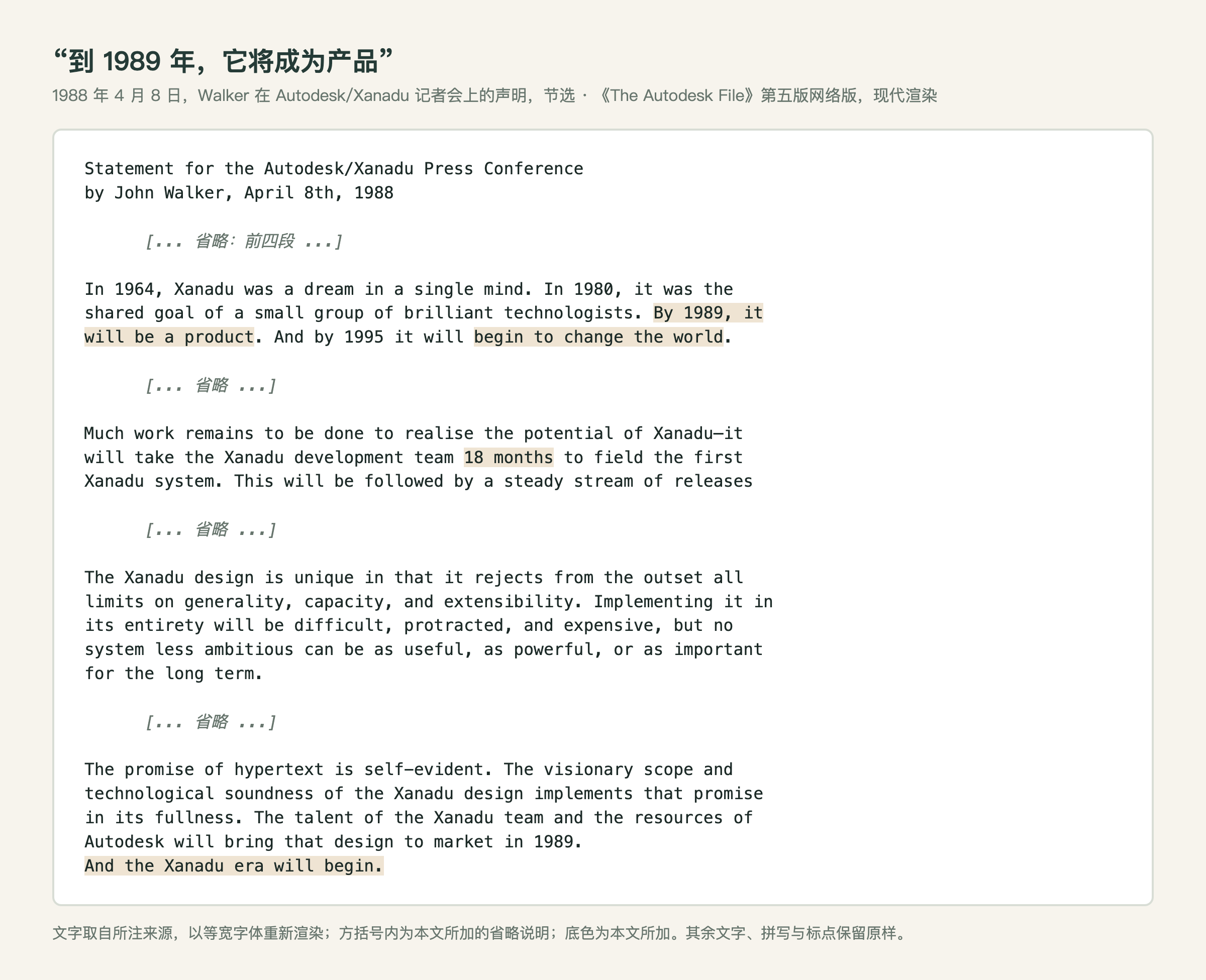
Walker’s statement at the Autodesk/Xanadu press conference, 8 April 1988, four paragraphs excerpted. Text from the online edition of The Autodesk File, fifth edition, edited by John Walker and preserved at fourmilab.ch, re-rendered in a monospaced font, omissions marked in square brackets, background shading added for this article. © John Walker; quoted here as a historical excerpt.
Offstage, Nelson did the public talking. In July 1989 Jakob Nielsen, a Danish usability researcher, attended the second hypertext conference in York, England, and wrote a trip report afterward. “One of the main elements in Nelson’s talk was his relief that he had finally been recognized by a major company”: Autodesk had bought Xanadu and was going to release it shortly, and “They are planning to release the product in the first quarter of 1990 in the form of software keeping track of addresses of information which is constantly moving around.” In 1997 Nielsen added a note after that passage: “of course, we now know that Xanadu remained vaporware for many years after these projections.”9
On the programmers’ side in Palo Alto, the 1981 design was in fact nearly done; it was later called Xanadu 88.1, after the year it was nearly finished. It was a server that managed addresses, versions and links, and it ran on a small scale, but it had no interface for ordinary users and had not been through quality control. Then Miller, as chief designer, began a redesign. The new version was called 92.1, after the delivery date set later, and was kept as identical code in two languages, Smalltalk and C++. The reason for the rewrite gets half a sentence in the 1999 technical introduction: “development was stopped in favor of an improved design.” Wired’s version is that Gregory sent out an alpha version: “They examined it. It was broken,” and the work started over. Years later Gregory still resented Miller and Mark Stiegler, whom Autodesk had sent to run things: “I had something that was within six months of shipping.” In the year Walker told the press 18 months, the programmers had already decided to change the design.10
“They Do Not Fit into Autodesk’s Core Business”
In March 1992, nearly four years after stepping down as chairman, Walker gave an interview as the company’s founder: “Xanadu’s great today, but it’s about 100 times too slow. Well, time will solve that.” Time did not get the chance. Autodesk’s stock had fallen from more than $60 the year before to 23 1/2; in April a new chief executive, Carol Bartz, took over; and on 20 August, at 1:20 in the afternoon, the company announced it would divest two companies in its information systems group, AMIX, an online marketplace for buying and selling information, and the Xanadu Operating Company: “Both AMIX and Xanadu are important companies with exciting futures, but they do not fit into Autodesk’s core business.” A note to employees said the ties would be severed at the end of 30 days, which the two companies could use to find other funding.11
Nelson said he had sensed trouble half a year before that. The Wired reporter wrote that at a Xanadu meeting in 1992 he “first felt the cold shock of reality”: “This feeling came over me - my God, they are not going to do it,” he says. “I had believed them all this time.” The reporter put that meeting in the summer; Nelson later corrected him, saying that what he had told the reporter was February. He changed the month and left the sentence alone. Within those 30 days the programmers moved out of their Palo Alto offices and into the home of Dean Tribble, one of the programmers, and ownership of the company reverted to the programmers and a few longtime supporters, with Gregory and Nelson owning about half between them. Jonathan Shapiro, who had become chief executive after Stiegler left, hoped to take the transitional funding and a working demonstration and get a deal with Kinko’s or another publisher within the 30 days. Nelson nominated Gregory to the board, which gave the two of them together a veto over any plan, and by his own account: “The reaction,” he says, “was as if I had set fire to the curtains.” By the time the fight was over, Kinko’s senior management had stopped returning phone calls and most of the transitional funding had gone on lawyers’ fees. On the Kinko’s episode Nelson answered with a single line: “Mr. Wolf seems to have no idea what my lifelong dream is, though I have made no secret of these matters. To have Xanadu eaten by Kinko’s was not it.” Of Shapiro, he said he “greatly respect[s] Shapiro as a professional,” “But he and I strongly disagreed on what to do next, and Mr. Shapiro is highly confrontative. Well, maybe we both are.”12
Then everyone scattered. A new company called Memex licensed the server technology and hired Miller and several programmers, who moved back into the building Xanadu had used in the Autodesk years. Gregory did not go at first; only at the end of 1994, after the programmers fell out with Memex and left, did Memex’s owner hire him to finish the code. The Xanadu trademark went back to Nelson. In 1993 Nelson rethought the whole thing: instead of waiting for the software, he wrote down who pays, who gets paid and who may quote whom as a set of rules, called it “Xanadu Light,” and licensed its development to Andrew Pam, a programmer in Melbourne. In 1994 he went to Japan. After Autodesk left, Xanadu split into three things: a pile of unfinished code went to Memex, a trademark went to Nelson, and a minimal specification went to Australia.13
“Nice Try”
While Xanadu was breaking up, the Web was quietly growing in a corner. The official chronology the Xanadu project posted in 1999 has a parenthesis: “(In 1992, Tim Berners-Lee introduced the World Wide Web as a text-based 1-way hypertext system. Ca. 1994, NCSA introduced the Mosaic browser (designed by Marc Andreessen), which added graphics directly into the pages. In late 1994 it began to really take off, at exactly the speed and timetable Nelson had predicted in 1990— for the Xanadu publishing system.)” The years in the parenthesis do not match the ones checked in earlier pieces of this series; the chronology puts the Web a year later than it was. In February 1995 Nielsen, the same researcher who had heard Nelson speak at York in 1989, wrote in a book: “It is interesting to contemplate the fact that Mosaic and the WWW more or less succeeded in establishing a universal hypertext system in just three years, even though Ted Nelson could not get his Xanadu system accepted in thirty years of trying.”14
Meanwhile Xanadu was facing more and more doubt from the press. In June 1995 Wired magazine ran a long article by the reporter Gary Wolf, “The Curse of Xanadu.” The Swarthmore summer, the sign on Gregory’s door and the fight during those 30 days, in the sections above, come mostly from it. The article is long, seventeen chapters, running from Nelson’s childhood to Sapporo in 1994; Wolf talked with Nelson many times and interviewed Gregory, Miller and Walker. The deck under the headline set the tone at once: Xanadu “was supposed to be the universal, democratic hypertext library,” and “Instead, it sucked Nelson and his intrepid band of true believers into what became the longest-running vaporware project in the history of computing - a 30-year saga of rabid prototyping and heart-slashing despair. The amazing epic tragedy.” The text opens with Nelson at the wheel: “I said a brief prayer as Ted Nelson - hypertext guru and design genius - took a scary left turn through the impolite traffic on Marin Boulevard in Sausalito.” With one arm resting on the back of the seat, he turned to Wolf: “I’ve been compiling a catalog of driving maneuvers,” he said. “It’s one of my unfinished projects.” Next comes a paragraph on his many pockets, holding an audio recorder, cassettes, and pens in several colors. Only a few paragraphs later does Wolf deliver his verdict: “Xanadu, a global hypertext publishing system, is the longest-running vaporware story in the history of the computer industry. It has been in development for more than 30 years.”
Wolf did not write Xanadu up as a joke. Among insiders, he said, it “is sometimes treated as a joke, but this is superficial”; people like Walker had poured millions of dollars and years of effort into it. What he set out to explain was why so many clever people had failed to build it, and his answer landed on Nelson himself: a tiny attention span, a habit of recording everything, “Nelson records everything and remembers nothing.” Xanadu was to have been his cure, and he called on a team of professionals, some of them his closest friends and disciples, to assist with the procedure: “In the end, the patient survived the operation. But it nearly killed the doctors.” The last chapters turn to the Web. “What the Web is doing is easy,” Miller said. It lacked nearly every advanced feature they had been trying to build: “There is no transclusion.” And, “We’ve got to use all of our technical insights to migrate the Web to a higher plane.” Wolf called Nelson at 5 a.m. Sapporo time, since he slept in the afternoon and worked all night; he was promoting transcopyright, a permission scheme for paying for quotation. Nelson’s response to the Web was “nice try.” “It will be finished,” he added. “The only question is which decade.”15
When it came to a war of words, Nelson was not one to sit still. He posted a rebuttal on his own website, “Errors in ‘The Curse of Xanadu,’ by Gary Wolf.” It opens with a notice that “Xanadu” is a registered U.S. trademark, and then: “This is a new media era. The subject can talk back rather freely now. Let’s try it.” He had meant, he said, to correct only hard factual errors, but there were “so many carefully concocted edge cases of marginal phrasing” that he would go through the article in sequence. Then a subheading: “PARAGRAPH 1: four errors of fact. Good start.” The article’s first sentence has him turning left on Marin Boulevard in Sausalito: “There is no Marin Boulevard in Sausalito. He means Bridgeway.” The reporter wrote that his file folders, made from envelopes, were “amputated by a hired printer”: “I do it myself.” The reporter wrote that in 1969 he was “hanging around Brown University”: “Ah yes, ever the parasite.” The reporter wrote that he would “wave his hands furiously in front of the white boards”: “Presumably I spoke too? Or did I just wave my hands?” The reporter wrote that Computer Lib was “a far subtler book than Nelson set out to write”: “Thank you, Mr. Wolf, for so quickly qualifying what came dangerously close to being a compliment.” The reporter wrote that Nelson lacked technical knowledge, and he answered with one word, which this series does not print; it is in the footnote. Further down come the points that mattered. The Silver Agreement dated from 1983, not from 1988 as the reporter had it, and he gave that one a line in capitals, “A COMPLETELY INCORRECT STATEMENT, THOROUGHLY CONFOUNDING WOLF’S NARRATIVE”; the “nice try” line was “a pretty seriously out-of-context quote. I have great respect for the Web and great personal liking for Tim Berners-Lee.” The same month, asked on a radio program whether the article amounted to libel, he answered: “Not almost, definitely.” The errors he picked out, from the street name to the year, were errors; the verdict of “longest-running,” he did not overturn.
Reading the rebuttal, I don’t get the sense of a man licking his wounds. It reads more like someone who has just found a fun new thing: with a web page, the person written about could for the first time talk back in public on his own, so he talked back one sentence at a time until it became a line-by-line annotation, even answering the reporter’s remark that the book’s layout was confusing: “Perhaps confusing to Mr. Wolf, the neatness freak.” On the same page he said that “the software of today’s computer world I find revolting,” and that he was “still waiting for the way I think it ought to be.” He would keep this fight going for many years.16
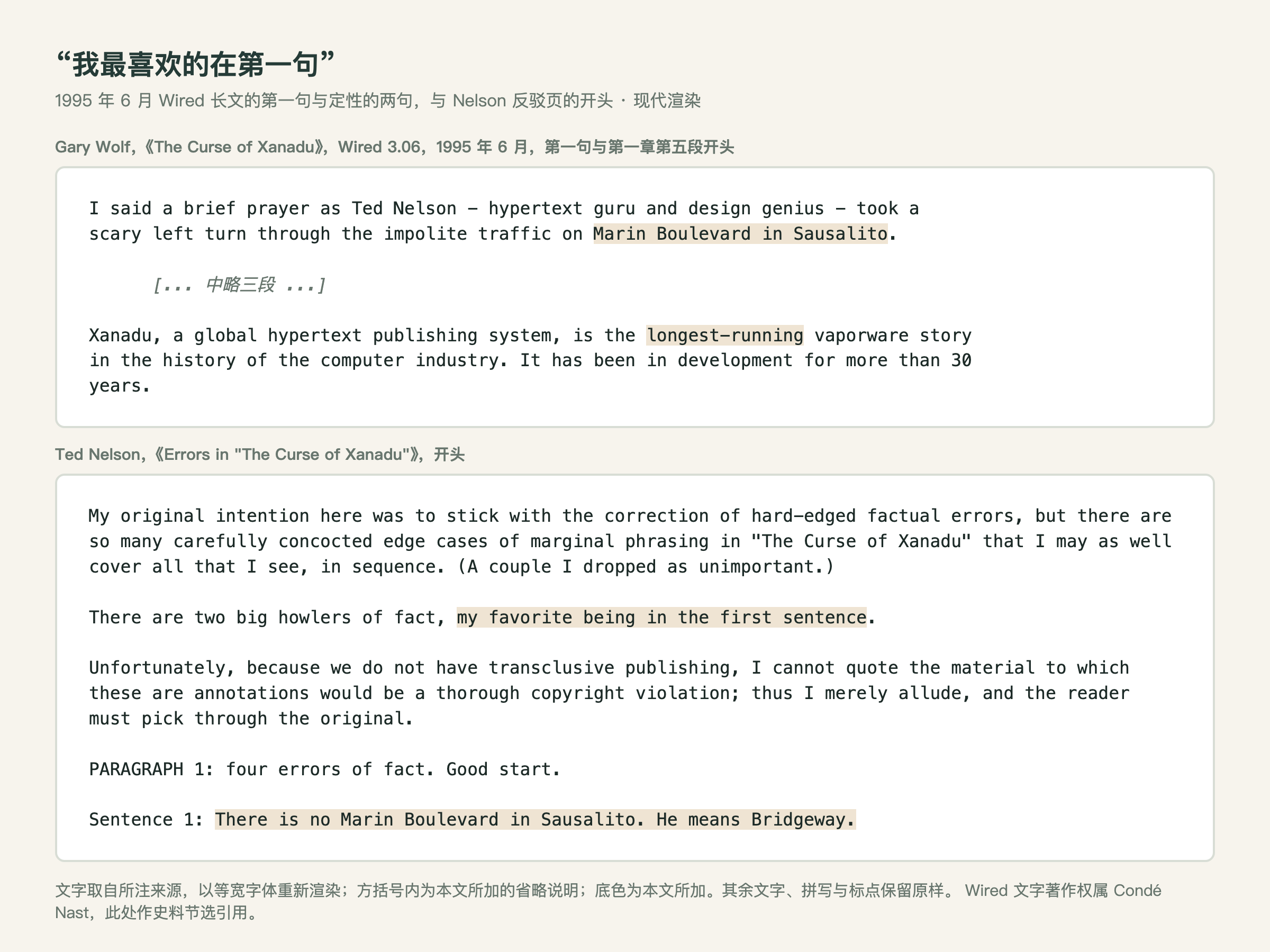
Above, from Gary Wolf’s long article in Wired, June 1995: its first sentence and the two sentences in chapter one that pass judgment on Xanadu; below, the opening of Nelson’s rebuttal page. Text from a web mirror of the article and Nelson’s rebuttal page, re-rendered in a monospaced font, omissions marked in square brackets, background shading added for this article. Wired text © Condé Nast; quoted here as a historical excerpt.
“Today the World Is Very Different”
Five years after the Web took off, Nelson turned in a paper. He had been invited to Japan in 1994 and set up a hypertext lab in Sapporo, and from 1996 he taught at Keio University. In August 1999 he wrote “Xanalogical Structure, Needed Now More than Ever” for ACM Computing Surveys; xanalogical is his coinage, meaning Xanadu-like. He wrote: “the World Wide Web is a delivery system for separate closed units— a system which allows only embedded links pointing outward. This is simple but naive— creating a tangle of ever-breaking one-way links, breaking whenever documents are moved or modified.” And: “For political and epidemiological reasons, the World Wide Web has taken the niche that the Xanadu project was aiming for.” Then this: “We were working for a much better world. In other words, the World Wide Web is precisely what we were trying to prevent.” In the same paper he settled his own accounts: “some seem to think that our software concepts were invalid because we did not deliver product. This is absurd.” The project “suffered from the ‘too many cooks’ syndrome at both design and administrative level. (Everyone believed the project was important, and there was a good deal of jockeying to influence or control it.)” The Silver Agreement had reduced his role “to spokesman and eventually fall guy.” He put the failure to ship down to too many cooks and that agreement, and did not change a word of the design. The paper ends by saying that the Xanadu Operating Company “retained the rights to the software as developed under Autodesk, and has now officially decided to make this code available under Open Source.”17
Monday, 23 August, Monterey, California, the O’Reilly Open Source Conference. The week before, the board of the Xanadu Operating Company had voted to rename it Udanax.com, Xanadu spelled backward; the two sets of “Xanadu secret code,” versions 88.1 and 92.1, went on the web that day as Udanax Green and Udanax Gold, under the X11 license, free for anyone to use. The udanax.com home page read “Opening Monday August 23, 1999,” and explained that when the work began, “keeping this work under trade secret seemed both standard and prudent. Today the world is very different.” Green was written in C and ran on a small scale; Gold “was still unfinished when Autodesk dropped the Xanadu project in 1992.” The software writer Dave Winer wrote on his website that there were only two reporters there, and that he later asked Gregory whether the software really works: “He said it does.” The Register reported three days later that the server code was “unusable by those who haven’t lived through its history,” and quoted Nelson: “trying to fix HTML is like trying to graft arms and legs onto a hamburger.” The 9 p.m. session was led by Gregory. Counting from the house he rented at Swarthmore in 1979, he was the one person who had been there for all twenty years. I take that day as Xanadu’s white flag on commercialization: trade secrets kept for twenty years were given away, free for anyone to use, from a system whose whole idea had been that someone would pay for every quotation.18
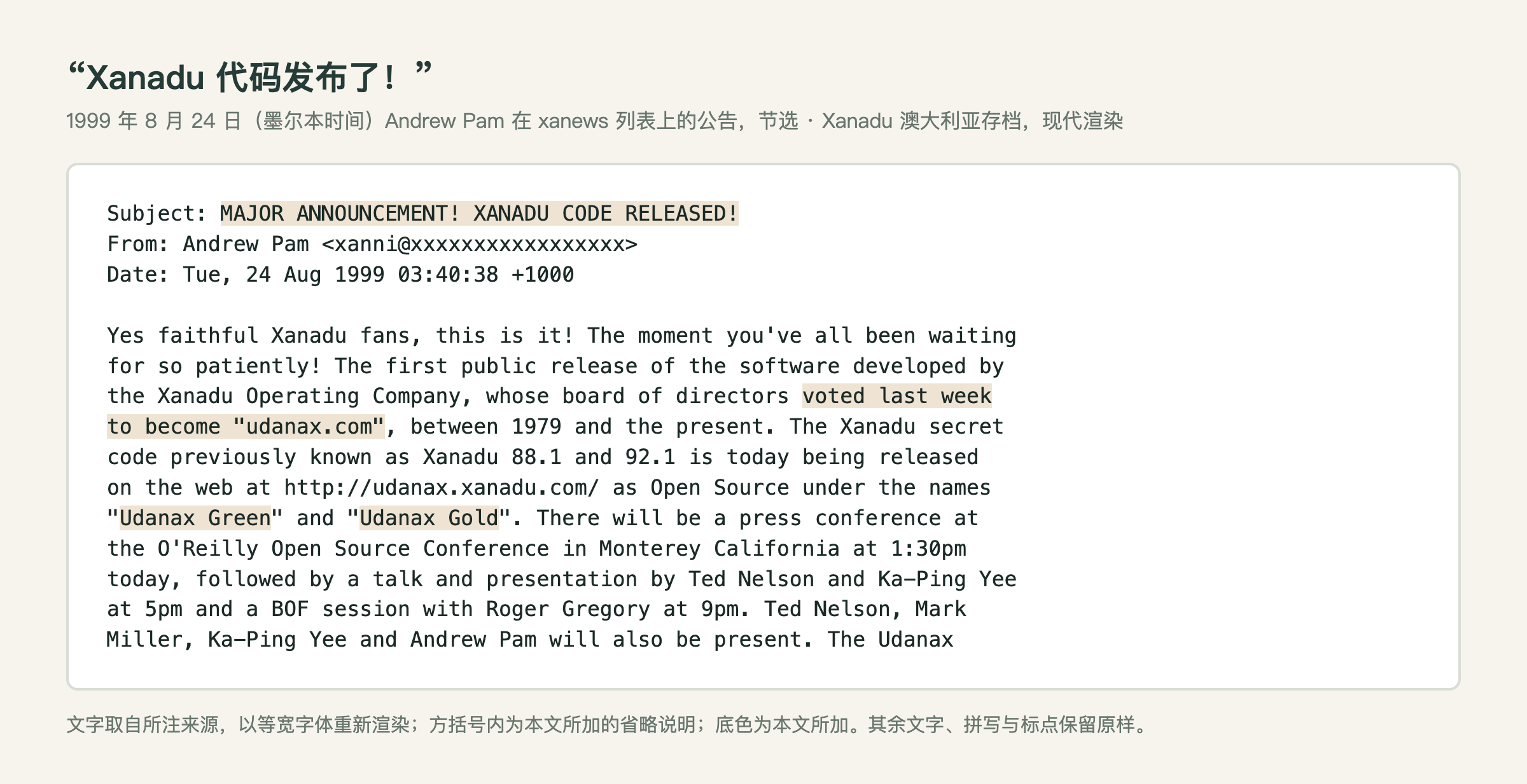
Andrew Pam’s announcement on the xanews mailing list, 24 August 1999 (Melbourne time), excerpt. Text from the Xanadu Australia list archive, re-rendered in a monospaced font, email addresses redacted as in the archive, background shading added for this article. By Andrew Pam; quoted here as a historical excerpt.
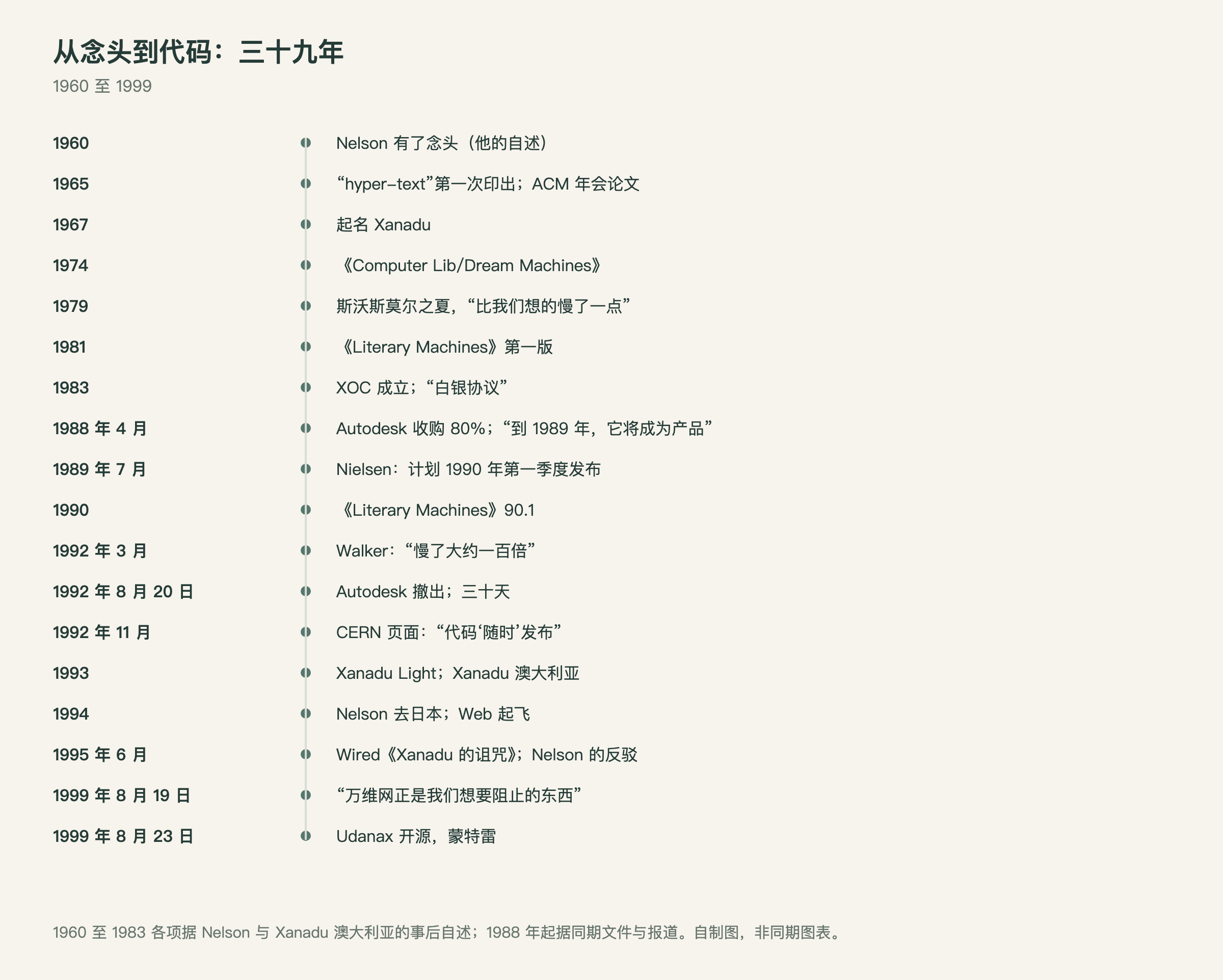
From idea to code, 1960 to 1999. Items from 1960 to 1983 rest on the later accounts of Nelson and Xanadu Australia; from 1988 on, on contemporary documents and reports; sources are in the footnotes. Drawn for this article; not a contemporary chart.
“We Screwed Up in the 1980s”
After the code was out, Nelson kept going. On 24 April 2014, at an event at Chapman University in California, he released OpenXanadu, written by the programmer Nicholas Levin, which runs in a web browser. It is a single document assembled from quoted passages of eight other works, among them the King James Bible and the Wikipedia article on Steady State Theory, with each passage connected to its source, side by side, lines drawn between them; the directions warn users “don’t touch the mouse!” and you move through it with the spacebar and arrow keys. The Guardian’s headline in June was “World’s most delayed software released after 54 years of development,” and it quoted Nelson: “We screwed up in the 1980s, and missed our chance to be world wide hypertext (the web got that niche). However, we can still compete with PDF, which simulates paper, by showing text connections.” In 1999 he had said that failing to ship did not make the concepts invalid, “This is absurd”; fifteen years later he said “we” screwed up. As I read it, what he owned up to was what went wrong in the eighties, not a mistake in the design.19
He had not let go of the 1995 fight either. In December 2013, at Chapman University, he recorded a video an hour and forty-two minutes long, The Jackal’s Curse: A Feature-Length Reply to “The Curse of Xanadu,” and in August 2020 he put it on his YouTube channel. The first sentence of the description says Wolf’s article “is full of distortions if not outright lies”; the second is “The Jackal’s 1995 attack in Wired Magazine still spreads its poison”; then it asks “why the magazine chose to act with such viciousness against both Ted Nelson and Roger Gregory.” Eighteen years on, he was defending Gregory as well as himself. In 1995 he had turned a web page into a way of talking back; this time it was video.20
In December 2024 someone in San Francisco threw a party for the fiftieth anniversary of Computer Lib. The host had gathered a large collection of Nelson memorabilia: the book, his Swarthmore mimeograph magazines, and several vintage computers running various Xanadu implementations. Nelson, 87 that year, could not attend. Among the guests was a former Xanadu programmer from the Autodesk era, who described prototyping Xanadu in Smalltalk, cross-compiling it to C++, then compiling the C++, which “took about a week to compile.” Also there was the independent writer Gwern Branwen, whose own website, Gwern.net, is a hypertext full of popups and sidenotes. He poked at the old machines briefly and, like most of the guests, gave up; the interface was too alien. But one look at the screen showing the classic demo, the opening of Genesis with lines zig-zagging off to the right, was enough for “a sudden realization: ‘Oh my god—It’s completely unreadable.’” The lines crisscrossed into clutter and the screen was small: “Even as you simply scrolled, for many possible positions, due to the lines you were unable to read anything!” His conclusion was harsher than Wolf’s. The problem was not the interface, and not the team: “The whole concept of side-by-side range transclusions is a solution in search of a problem.”21
On 1 September 2026, Nathan Sobo of the code editor Zed published a post on the company blog, “Xanadu Was Waiting for Agents.” Its first sentence is “Ted Nelson has been on my mind a lot this year.” He boiled Xanadu down to two rules, “Never copy, always reference” and “Never overwrite, always version,” and then took Nelson’s side: “Wired depicted Nelson’s story as one of mismanagement, but I think he’d just specified Xanadu decades before its dependency tree existed.” Permanent naming, storage cheap enough never to delete: none of those parts existed yet. He also said that on one detail Nelson “dreamt too small. The final dependency he was missing was a new kind of user,” meaning AI agents that can follow references, versions and discussion layer after layer. Toward the end the post turns into an introduction to Delta, a product the company launched in August, and its last lines are: “Sixty years is a long time for an idea to wait for its users. They’re here now.”22
The same question was asked in 1995 and is still being asked in 2026: why Xanadu never got built. Wolf said it was the man; Nelson said in 1999 it was too many cooks and the agreement, and in 2014 that it was the eighties; the old programmer talked about a week-long compile; Gwern said it was the concept itself; Sobo said the parts had not arrived and the users had not come. Every promise Xanadu made, links that never break, documents that cannot be withdrawn, royalties settled by the byte, needs someone to guarantee it for the whole system; Berners-Lee’s 1992 letter said precisely that once servers are run by different people, there is no one left to give that guarantee. Sobo’s product can take a xanalogical shape, I suspect, because a code repository already has a guarantor, and the world’s literature does not. So I think the genius and the over-design in Xanadu are the same thing: take away the guarantee and it is more or less the Web; keep it and it can never get out the door. I love it because it thought one thing all the way through; I use the Web every day because the Web went out the door before thinking it through. The CERN page was not wrong. The code was due out any time now; it just did not say how long any time would be.23
The cover is the Eternal-Flaming-X logo of Project Xanadu, taken from the Project Xanadu home page and placed at its original size on black. “Xanadu” and the logo are registered trademarks of Project Xanadu, used here for reference; this piece has no affiliation with the project.
Footnotes
-
The Ted Nelson and Xanadu page in the CERN hypertext snapshot of 3 November 1992, signed TBL: “Ted Nelson originally invented the word ‘hypertext’ for ‘non-sequential writing’. His long-standing interest in all things related to HT became the Xanadu project. The Xanadu Operating Company is now owned by Autodesk, but the project continues. Code is due out ‘any time now’.” “He publishes it himself (I have a copy of LM 90.1 - TBL ). This is essential reading as background, enthusiathm and ideas on hypertext.” The later version (w3.org/Xanadu.html) reads “The Xanadu Operating Company was owned for a while by Autodesk, but later dropped. (Not clear in 1993 what is going to happen there)”. The two versions are compared in Autodesk 1992 年撤出 Xanadu 与 CERN 同期对 Xanadu 的描述 . On the nature of the sources: the history before 1988 is mostly the later recollection of Nelson and his colleagues; the 1995 Wired article is a reporter’s after-the-fact narrative, rebutted by Nelson sentence by sentence; the Autodesk documents, Nielsen’s 1989 trip report and the 1999 announcements are contemporary; the sections from 2014 on rest on contemporary reports and on the accounts of participants and onlookers. ↩
-
The idea in 1960 and the word chosen in 1963 and published in 1965 are from Project Xanadu’s official chronology of 20 August 1999 (the page is marked xuHistory 99.08.20, carries no personal byline and is linked from Nelson’s home page; it is treated here as the account of the project and of Nelson’s side), “1960: Ted Nelson gets the idea of hypertext. (Word chosen 1963, published 1965.)”, and from his 1998 page Who I Am; both are later recollections. His degrees are from the same page: “B.A., Philosophy, Swarthmore. 1959 / M.A., Sociology, Harvard, 1963”. The first-year term project and the incomplete are from the 1995 Wired article, “Hypertext was invented during his first year at Harvard, when Nelson attempted, as a term project, to create a ‘writing system’ … Nelson failed to finish the coding, and had to take an incomplete for the course,” which is the reporter’s account; in this passage Nelson’s rebuttal page disputes only the comparison with the first experimental word processors and the description of a circle of Harvard professors, not the project or the incomplete. That “hyper-text” first appeared in print is from an explanatory page in the Xanadu Australia archive, which refers to the Vassar College Miscellany News of 3 February 1965; the newspaper itself was not checked. The 1965 paper is “Complex Information Processing: A File Structure for the Complex, the Changing, and the Indeterminate,” Proceedings of the ACM 20th National Conference, 1965, pages 84 to 100; only its title and venue were checked. ↩
-
The 1967 date and the explanation of the name are from the 1999 chronology (above): “(Name ‘Xanadu’ chosen 1967.)” “About the name: No, we did not get it from Olivia Newton-John.” “This poem’s tradition also associates the name ‘Xanadu’ with memory and lost work, because Coleridge said he lost part of the poem due to a mundane interruption. We chose the name ‘Xanadu’, with all these connotations, to represent a magic place of literary memory and freedom, where nothing would be forgotten.” The 1980 film starring Olivia Newton-John is from item 7i of the Xanadu FAQ: “The 1980 movie ‘Xanadu’ starring Olivia Newton-John as a muse was also named after the Coleridge poem”. The interruption is Coleridge’s own account in his preface to “Kubla Khan,” which Wired paraphrases as “As he was about to transcribe them, he was interrupted by a visitor”; it is used here only to explain the name. The door sign is from Wired, “On the door of his office at Memex was a sign that said: ‘S.T. Coleridge and Sons. Danger.’”, seen by the reporter in the fall of 1994, the same month he interviewed Gregory at home (“Last fall, I visited Gregory in Palo Alto”; the article appeared in June 1995). ↩
-
Computer Lib/Dream Machines was self-published in 1974 and reissued by Microsoft Press in 1987, the latter noted in Autodesk’s press release of 8 April 1988, “(recently re-issued by Microsoft Press)”. The 1974 introduction, “Any nitwit can understand computers, and many do,” is quoted from the Wired article; the book itself was not checked. The typewriter, the paste-up, the trip to the printer and the third of the copies misbound are from the same article (“When he discovered that about a third of the books had their pages in the wrong order, he had the printer unbind the flawed copies and recollate and rebind them”), the reporter’s account; Nelson’s rebuttal disputes only the “1,200-page manuscript” and the missing table of contents, not the printing story. Teaching at Swarthmore is from Wired, “Swarthmore had offered him a nondepartmental position teaching his own work”; the rebuttal mentions Miller speaking as a guest in Nelson’s class, which supports it. The years were not checked. ↩
-
The Swarthmore summer of 1979 and who was there are from the official chronology, “1979: ‘Swarthmore summer’ of specification and design amongst Ted, Roger Gregory, Mark Miller, Stuart Greene, Eric Hill, Roland King.” (a later account). Gregory renting the house, Miller at Yale (“Mark Miller had returned to Yale to begin his senior year”; he was 19 in 1976, when he first spoke to Nelson’s class, “In 1976, Mark Miller, an insecure 19-year-old”), “musing over the difficulties of making hypertext code that really worked,” “That summer was Xanadu’s golden age,” and “‘The summer went a little slower than we thought,’ remembers Gregory.” are from Gary Wolf, “The Curse of Xanadu,” Wired 3.06, June 1995 (full-text mirror), the reporter’s after-the-fact narrative, based on interviews in 1994 and 1995. Nelson’s rebuttal is at Errors in “The Curse of Xanadu”: “I am not aware that any of them considered themselves ‘disciples;’ I certainly didn’t. We were friends.” The rebuttal page is undated; its remark that he moved out “last October, six months before this article was published” places it in 1995. ↩
-
The design is summarized from Samuelson and Glushko’s 1991 analysis of Xanadu (see the samuelson footnote of the third piece ), Berners-Lee’s 1992 page on unique names and royalties (see cern), and Nelson’s 1999 paper (see paper99): “two-way links which stay in place as documents change and move,” “the unit of sale of content would not be the book or magazine but the sentence or paragraph, micropurchased.” The years of the coinages are from Who I Am, “‘hypertext’ and ‘hypermedia’ (1965)… ‘cybercrud’ (ca. 1967)… ‘docuverse’ (1981) / ‘transclusion’ (1987) / ‘micropayment’ (1992)”, his own later account; the gloss on cybercrud is this piece’s summary of how he uses it. The editions of Literary Machines are from the publication years listed in edition 93.1 (1980 to 1993) and Berners-Lee’s note “LM 90.1”; the contents of the editions were not compared. “I think it is because he worries…” is this piece’s inference; the quotation is from the rebuttal page, “This is not a ‘theory of language,’ it is a set of useful precepts for fast-changing conceptual environments.” “These pieces interlock” is this piece’s judgment. ↩
-
XOC’s founding by Gregory in 1983 and the Silver Agreement are from the official chronology: “XOC, Inc. was founded by Roger in 1983 to productize this work for the technical community. The infamous ‘Silver Agreement’ of that year granted Nelson full rights to the networked publishing system in return for abandoning any authority over design, management or business arrangements not affecting the publishing system.” Nelson’s 1999 paper: “my own role was reduced to spokesman and eventually fall guy, by the so-called ‘Silver Agreement’, which barred me from a role in design or administration.” The rebuttal page: “the Silver Agreeement was crafted in 1983, because I demanded it, and it was incorporated into the Autodesk agreement in 1988 because I demanded it,” “the knock-down-drag-out meeting in 1983 that resulted in the Silver Agreement,” “a conclave in the living room in San Antonio in 1983”; it calls Wired’s dating of the agreement to 1988 “A COMPLETELY INCORRECT STATEMENT, THOROUGHLY CONFOUNDING WOLF’S NARRATIVE.” Autodesk’s press release of 8 April 1988 says instead that “In 1979 Mr. Nelson joined with several others to found Xanadu Operating Company”; this piece follows Nelson and the chronology in giving 1983 and notes the discrepancy here. “I suspect that in 1983 he did not count giving up design and management as a price” is this piece’s inference, resting on his having demanded the agreement and having kept all rights to the publishing system; “sixteen years later” counts from 1983 to 1999. “Offstage” is this piece’s metaphor, based on the terms of the agreement and his later role as public spokesman (see nielsen89). ↩
-
The Hackers’ Conference of October 1987 and the 80 percent purchase are from the editor’s note to the Xanadu chapter of John Walker’s The Autodesk File, fifth edition: “At the Hackers’ Conference in October 1987 I spoke to Roger Gregory, President of Xanadu Operating Company,” “Autodesk would purchase 80% of Xanadu and fund the development of the product.” The note was written around 1994. No party’s documents give the price; the Xanadu FAQ says Autodesk spent “on the order of five million US dollars” in all, which no Autodesk document supports, so it is not used. John Walker, “Statement for the Autodesk/Xanadu Press Conference,” 8 April 1988, in the same chapter: “In 1964, Xanadu was a dream in a single mind. In 1980, it was the shared goal of a small group of brilliant technologists. By 1989, it will be a product. And by 1995 it will begin to change the world.” “it will take the Xanadu development team 18 months to field the first Xanadu system”. Press release “Autodesk Announces New Fellowship,” Sausalito, 8 April 1988: “Ted Nelson, maverick software designer, flamboyant legend, idealistic prognosticator, eloquent generalist, and now Distinguished Fellow at Autodesk. Ted Nelson is where he belongs.” Both are contemporary documents. “I suspect he did not mind reading it” is this piece’s inference, resting on the rebuttal page’s “My title was Autodesk Distinguished Fellow, thanks.” and on his 1998 page listing Walker among four mentors, “Mentors (aside from my family): Leo Rosten / Michael Scriven / Thomas C. Schelling / John Walker”. The distance to Palo Alto is from Wired, “The programmers’ offices were more than an hour down California Highway 280, in Palo Alto.” Walker’s farewell on stepping down as chairman, 10 June 1988, says “We expect to ship the first commercial Xanadu system in less than 18 months.” (Valedictory chapter). ↩
-
Jakob Nielsen, Hypertext’2 Trip Report, July 1989 (a contemporary report, with a note added in 1997): “One of the main elements in Nelson’s talk was his relief that he had finally been recognized by a major company in the form of Autodesk which had bought Xanadu and was going to release the Xanadu file system shortly.” “They are planning to release the product in the first quarter of 1990 in the form of software keeping track of addresses of information which is constantly moving around.” “[Note added 1997: of course, we now know that Xanadu remained vaporware for many years after these projections.]” The conference was Hypertext’2, held in York at the end of June 1989. ↩
-
That Mark Stiegler was an Autodesk employee who, at the 1992 divestment, left Autodesk to join AMIX and Xanadu is from Bartz’s note to employees, “Mark Stiegler, who is an Autodesk employee, has chosen to leave Autodesk and officially join AMIX and Xanadu.” His role between 1988 and 1992 is given here as Xanadu’s manager on the strength of Wired’s account, not checked. The names 88.1 and 92.1 are explained in the official chronology: “Udanax Green (formerly Xanadu 88.1, for its time of near-completion and shelving), Udanax Gold (formerly Xanadu 92.1, for the intended delivery date)”; Miller as chief designer is from the Xanadu FAQ, “Work continued with Mark Miller as chief designer.” “A server that managed addresses, versions and links” is this piece’s summary of what Nielsen recorded in 1989 and of the features listed in Autodesk’s 1992 press release; what 88.1 could demonstrate at the time is not recorded in contemporary material. Xanadu Technologies — An Introduction, the joint disclosure by Udanax.com and Project Xanadu of 23 August 1999: “Udanax Green ran on a small scale, but development was stopped in favor of an improved design, the less-finished Udanax Gold,” “Design of 92.1 began in 1988. … The group chose to maintain identical parallel code in a carefully-chosen mutual subset of Parc Place Smalltalk and C++”. The Xanadu FAQ (maintained by Andrew Pam, version 1.56, 2002): “The 1981 design (now called Xanadu 88.1) was topped off but Miller began a redesign. Xanadu 88.1 was not subjected to quality control or released as a product.” Wired: “Gregory got far enough to send an alpha version out to some users to examine. They examined it. It was broken.” “‘I had something that was within six months of shipping.’” Dating the change of design to 1988 rests on the 1999 technical introduction, a later account; The Autodesk File contains no contemporary Autodesk document on Xanadu’s progress between 1988 and 1991. ↩
-
Walker’s interview of 26 March 1992, in The Autodesk File, MicroTimes chapter: “Xanadu’s great today, but it’s about 100 times too slow. Well, time will solve that.” The stock price and Bartz’s arrival are from Wired: “From its high of more than $60 in 1991, Autodesk had dropped to 23 1/2 by mid-February 1992.” “by April, Autodesk had found a new person to take charge”. The press release and note to employees of 20 August 1992 are in the Farewell, Xanadu chapter: “announced today, Thursday, August 20, at 1:20 p.m. PDT,” “Both AMIX and Xanadu are important companies with exciting futures, but they do not fit into Autodesk’s core business.” “Autodesk has officially given notice that it will sever it ties to AMIX and Xanadu at the end of 30 days.” All are contemporary documents. ↩
-
There are no contemporary documents for those 30 days; everything is from the 1995 Wired article: “It was not until a Xanadu meeting in the summer of 1992 that he first felt the cold shock of reality. ‘This feeling came over me - my God, they are not going to do it,’ he says. ‘I had believed them all this time.’” “The programmers vacated their Palo Alto offices and moved into Dean Tribble’s home.” “ownership of Xanadu Operating Company reverted to the programmers and a few other longtime Xanadu supporters. Roger Gregory and Ted Nelson now owned about half the company.” “When Marc Stiegler left Xanadu, Jonathan Shapiro became CEO of the newly independent company.” (Shapiro had first been brought in to write documentation: “was hired to write documentation.”) “Shapiro believed he could get Xanadu into a deal with Kinko’s or another publisher within 30 days.” “‘The reaction,’ Nelson says, ‘was as if I had set fire to the curtains.’” “Kinko’s senior management had stopped returning phone calls, most of Autodesk’s transitional funding had been spent on lawyers fees”. Nelson’s rebuttal: “Mr. Wolf seems to have no idea what my lifelong dream is, though I have made no secret of these matters. To have Xanadu eaten by Kinko’s was not it.” “I believe I told Wolf not summer but February of 1992.” The rebuttal neither confirms nor denies the Kinko’s story, the board fight or the legal fees. On Shapiro, Wired has “To Nelson, Shapiro was ‘an asshole.’”; the rebuttal replies, “Excuse me, but I greatly respect Shapiro as a professional. … But he and I strongly disagreed on what to do next, and Mr. Shapiro is highly confrontative. Well, maybe we both are.” “He changed the month and left the sentence alone” is this piece’s reading. ↩
-
Memex and where people went are from Wired: “When Memex offered to license the technology and hire some of the employees to complete it, Miller, Tribble, and Pandya … signed on. Gregory, while remaining a large shareholder of Xanadu Operating Company, did not go to work at Memex.” “It was the same building that had housed Xanadu during the years it was supported by Autodesk.” Gregory’s later hiring is also from Wired, “after the remnants of the Autodesk team scattered, Charlie Smith hired Roger Gregory to finish the Xanadu software,” which came after the programmers carried the machines out of Memex’s office at the end of November 1994 and were made to return them; “fell out with Memex and left” is this piece’s summary. The Xanadu FAQ: “Rights to continued development of the XOC server were licensed to Memex, Inc. of Palo Alto, California and the trademark ‘Xanadu’ was re-assigned to Nelson.” “1993: Nelson re-thought the whole thing and respecified Xanadu publishing as a system of business arrangements. Minimal specifications for a publishing system were created under the name ‘Xanadu Light’, and Andrew Pam of Serious Cybernetics in Melbourne, Australia was licensed to continue development as Xanadu Australia.” “1994: Nelson was invited to Japan and founded the Sapporo HyperLab.” The FAQ is Pam’s account of the project and is treated here as one participant’s version. “Three things” is this piece’s summary. ↩
-
The official chronology, dated 99.08.20, a later account: “(In 1992, Tim Berners-Lee introduced the World Wide Web as a text-based 1-way hypertext system. Ca. 1994, NCSA introduced the Mosaic browser (designed by Marc Andreessen), which added graphics directly into the pages. In late 1994 it began to really take off, at exactly the speed and timetable Nelson had predicted in 1990— for the Xanadu publishing system.)” Earlier pieces in this series date the Web’s public release to August 1991 and Mosaic’s first version to January 1993. Nielsen, The History of Hypertext, February 1995 (excerpted from his 1995 book): “It is interesting to contemplate the fact that Mosaic and the WWW more or less succeeded in establishing a universal hypertext system in just three years, even though Ted Nelson could not get his Xanadu system accepted in thirty years of trying.” ↩
-
Gary Wolf, “The Curse of Xanadu,” Wired 3.06, June 1995, read here in a web mirror; the article runs to seventeen chapters. The deck: “Ted Nelson’s Xanadu project was supposed to be the universal, democratic hypertext library that would help human life evolve into an entirely new form. Instead, it sucked Nelson and his intrepid band of true believers into what became the longest-running vaporware project in the history of computing - a 30-year saga of rabid prototyping and heart-slashing despair. The amazing epic tragedy.” The first sentence: “I said a brief prayer as Ted Nelson - hypertext guru and design genius - took a scary left turn through the impolite traffic on Marin Boulevard in Sausalito,” followed by “Nelson’s left hand was on the wheel, his right rested casually on the back of the front seat” and “‘I’ve been compiling a catalog of driving maneuvers,’ he said. ‘It’s one of my unfinished projects.’” The verdict opens the fifth paragraph of chapter one: “Xanadu, a global hypertext publishing system, is the longest-running vaporware story in the history of the computer industry. It has been in development for more than 30 years.” “During one of our many conversations”; “Among people who consider themselves insiders, Nelson’s Xanadu is sometimes treated as a joke, but this is superficial. Nelson’s writing and presentations inspired some of the most visionary computer programmers, managers, and executives - including Autodesk Inc. founder John Walker - to pour millions of dollars and years of effort into the project.”; “his tiny attention span … Nelson records everything and remembers nothing. Xanadu was to have been his cure. To assist in the procedure, he called upon a team of professionals, some of whom also happened to be his closest friends and disciples. In the end, the patient survived the operation. But it nearly killed the doctors.” Nelson’s rebuttal objects point by point to this kind of description, for example “My tapes are NOT coextensive with my waking life, but a small subset,” and calls the article’s treatment of Xanadu as a symptom of madness “gratuitously nasty and incomprehensible.” On the Web: “‘What the Web is doing is easy,’ Miller answered. He pointed out that the Web still lacks nearly every one of the advanced features he and his colleagues were trying to realize. There is no transclusion.”; “‘We’ve got to use all of our technical insights to migrate the Web to a higher plane,’ he said.” “Nelson, who recently moved to Japan, sleeps in the afternoon and works all night, so I called him at 5 a.m. Sapporo time.” “Nelson’s response to the Web was ‘nice try.’” “‘It will be finished,’ Nelson added. ‘The only question is which decade.’” Wired calls transcopyright “a contractual solution”; Nelson’s rebuttal says it “is not contractual. Like ‘shareware,’ it is a permission system,” and the main text follows him. ↩
-
Nelson, Errors in “The Curse of Xanadu,” by Gary Wolf: “Note that ‘Xanadu’ is a registered U.S. trademark.” (the first sentence under the title); “This is a new media era. The subject can talk back rather freely now. Let’s try it.” “My original intention here was to stick with the correction of hard-edged factual errors, but there are so many carefully concocted edge cases of marginal phrasing in ‘The Curse of Xanadu’ that I may as well cover all that I see, in sequence.” “PARAGRAPH 1: four errors of fact. Good start.” “Sentence 1: There is no Marin Boulevard in Sausalito. He means Bridgeway.” “My envelopes are not ‘amputated by a hired printer.’ I do it myself.” (Wired’s sentence is about file folders that “begin their lives as 8 1/2-by-11-inch envelopes, are amputated en masse by a hired printer”); on Wired’s “In 1969, Nelson was hanging around Brown University,” “Ah yes, ever the parasite.”; on “wave his hands furiously in front of the white boards,” “Presumably I spoke too? Or did I just wave my hands?”; on “a far subtler book than Nelson set out to write,” “Thank you, Mr. Wolf, for so quickly qualifying what came dangerously close to being a compliment.”; on “The print was tiny, and the layout confusing,” “Perhaps confusing to Mr. Wolf, the neatness freak.”; “This is a pretty seriously out-of-context quote. I have great respect for the Web and great personal liking for Tim Berners-Lee.” “the software of today’s computer world I find revolting. If others like it, fine, but I’m still waiting for the way I think it ought to be, and still working toward that goal.” Wired wrote “Nelson lacked the technical knowledge”; his answer was one word, “Bullshit.”, which the main text leaves out under this series’ rule against printing profanity. The radio interview is Jim Whitehead, Orality and Hypertext: An Interview with Ted Nelson, June 1995; asked whether the article amounted to libel, he said “Not almost, definitely”. “Not a man licking his wounds, more like someone who has just found a fun new thing” is this piece’s reading. ↩
-
Nelson, “Xanalogical structure, needed now more than ever: parallel documents, deep links to content, deep versioning, and deep re-use,” ACM Computing Surveys 31(4es), December 1999, read here in the author’s web version (marked 99.08.19, “tentatively accepted”): “the World Wide Web is a delivery system for separate closed units— a system which allows only embedded links pointing outward. This is simple but naive— creating a tangle of ever-breaking one-way links, breaking whenever documents are moved or modified.” “For political and epidemiological reasons, the World Wide Web has taken the niche that the Xanadu project was aiming for.” “We were working for a much better world. In other words, the World Wide Web is precisely what we were trying to prevent.” “some seem to think that our software concepts were invalid because we did not deliver product. This is absurd. The project suffered from the ‘too many cooks’ syndrome at both design and administrative level. (Everyone believed the project was important, and there was a good deal of jockeying to influence or control it.)” “XOC, Inc. retained the rights to the software as developed under Autodesk, and has now officially decided to make this code available under Open Source.” The published text may differ from the web version, whose page title reads “Xanalogical Structure: Now More Than Ever” and whose heading reads “Xanalogical Media: Needed Now More Than Ever”; the main text uses the published title. Teaching at Keio is from the Xanadu FAQ, “1996: Nelson became a Professor of Environmental Information at the Shonan Fujisawa Campus of Keio University.” “Did not change a word of the design” is this piece’s reading. ↩
-
Andrew Pam, MAJOR ANNOUNCEMENT! XANADU CODE RELEASED!, xanews list, 24 August 1999, 03:40 Melbourne time (the morning of the 23rd, Pacific time): “whose board of directors voted last week to become ‘udanax.com’” “The Xanadu secret code previously known as Xanadu 88.1 and 92.1 is today being released on the web at http://udanax.xanadu.com/ as Open Source under the names ‘Udanax Green’ and ‘Udanax Gold’. There will be a press conference at the O’Reilly Open Source Conference in Monterey California at 1:30pm today, followed by a talk and presentation by Ted Nelson and Ka-Ping Yee at 5pm and a BOF session with Roger Gregory at 9pm.” The udanax.com home page: “Opening Monday August 23, 1999,” “keeping this work under trade secret seemed both standard and prudent. Today the world is very different.” The license page: “are hereby open-sourced under the MIT X-11 License.” The technical introduction: “The Udanax Green code is in C.” “Xanadu 92.1 was still unfinished when Autodesk dropped the Xanadu project in 1992.” Dave Winer, Ted Nelson Returns, 24 August 1999: “the only other reporter was from Upside,” “I asked him if the software really works. He said it does.” Graham Lea, The Register, 27 August 1999: “unusable by those who haven’t lived through its history,” “trying to fix HTML is like trying to graft arms and legs onto a hamburger.” All are contemporary documents or reports. “The one person who had been there for all twenty years” rests on three facts, the house rented in 1979, the founding of XOC in 1983 and the session he led in 1999; he left and came back during the Memex period, and the phrase is this piece’s summary. “White flag on commercialization” is the author’s judgment, resting on the home page’s sentence about trade secrets and on the X11 license’s free, unrestricted terms; Udanax said nothing of the kind. ↩
-
Alex Hern, World’s most delayed software released after 54 years of development, The Guardian, 6 June 2014: “which was released without fanfare at an event at California’s Chapman University in late April,” “The version released on the internet, named OpenXanadu, is a simple document created using quoted sections from eight other works, including the King James Bible and the Wikipedia page on Steady State Theory,” “the directions warn users ‘don’t touch the mouse!’”, “‘We screwed up in the 1980s, and missed our chance to be world wide hypertext (the web got that niche). However, we can still compete with PDF, which simulates paper, by showing text connections.’” The article does not say whether Nelson’s words came from an interview or from the project’s web page. The release date of 24 April and the programmer Nicholas Levin are from kottke.org, 5 June 2014; no announcement from the Xanadu side was found. “Side by side, lines drawn between them” rests on the Guardian’s photograph and Nelson’s long-standing “parallel pages, visibly connected.” “What he owned up to was what went wrong in the eighties, not a mistake in the design” is this piece’s reading, resting on the second half of the same quotation, which still says it can compete with PDF. ↩
-
Ted Nelson, THE JACKAL’S CURSE: A FEATURE-LENGTH REPLY to “THE CURSE OF XANADU”, channel TheTedNelson; the page metadata gives an upload date of 22 August 2020 and a length of 6,105 seconds. The description: “‘The Curse of Xanadu’, by Gary Wolf, is full of distortions if not outright lies.” “The Jackal’s 1995 attack in Wired Magazine still spreads its poison. We consider some of his nasties and seemingly deliberate untruths, and ask why the magazine chose to act with such viciousness against both Ted Nelson and Roger Gregory.” “This is the fuller reply, recorded in December 2013 at Chapman University.” English Wikipedia dates the video to 2019; this piece follows the description and the page metadata. The video was not watched in full; the main text uses only its title and description. “Eighteen years” counts from 1995 to 2013. ↩
-
Gwern Branwen, Project Xanadu: Even More Hindsight, page marked as finished on 5 May 2025, the author’s own account of the December 2024 party: “a celebration of the 50th anniversary of hypermedia visionary Ted Nelson’s 1974 manifesto, Computer Lib/Dream Machines,” “copies of his Swarthmore College mimeograph magazines, and most impressive of all—several vintage computers running copies of various Xanadu implementations.” “Ted Nelson was still alive at age 87, but unfortunately could not attend.” “one of the attendees was one of the former Xanadu programmers from the Autodesk era,” “he described how they prototyped Xanadu in Smalltalk … but then had to cross-compile it to C++ and compile that… which took about a week to compile.” “I briefly poked at the Xanadu PCs, impressed that they were running at all, but I and most of the party-goers bounced off them. The UI was too alien.” “But I didn’t need to use them much to look at the screen displaying the stereotypical Project Xanadu demo, the opening of the Book of Genesis with its famous lines zig-zagging off to the right to denote transclusions or commentary on passages, and have a sudden realization: ‘Oh my god—It’s completely unreadable.’” “None of the ‘sidenotes’ were readable because the screen was so small. Even as you simply scrolled, for many possible positions, due to the lines you were unable to read anything!” “the UI wasn’t the real problem; and the problem, for all these many decades, wasn’t the team either. The whole concept of side-by-side range transclusions is a solution in search of a problem.” The programmer is not named by the author, and this piece does not guess. The week-long compile is that programmer’s recollection more than thirty years on, as retold by Gwern. ↩
-
Nathan Sobo, Xanadu Was Waiting for Agents, Zed company blog, 1 September 2026: “Ted Nelson has been on my mind a lot this year.” “To be xanalogical is to follow two rules: Never copy, always reference (also known by a Nelsonism, transclusion). Never overwrite, always version.” “He couldn’t build Xanadu because most of its parts didn’t exist, such as a way to name content that no authority issues, or storage cheap enough to never delete.” “Wired depicted Nelson’s story as one of mismanagement, but I think he’d just specified Xanadu decades before its dependency tree existed.” “On one detail — across a career of being told his dreams were too big — Nelson dreamt too small. The final dependency he was missing was a new kind of user.” “Sixty years is a long time for an idea to wait for its users. They’re here now.” The same site’s “Introducing Delta” post is dated 12 August 2026. This is a company introducing its own product, as the main text says, and is not treated as independent research on Xanadu’s history. ↩
-
This paragraph is the author’s own judgment and does not come from the sources. The explanations attributed to each party are in the wired, paper99, open2014, party and zed footnotes; the week-long compile was a difficulty the old programmer described, and Gwern does not say he blamed the failure on it, so setting it alongside the others is this piece’s simplification. “Every promise needs someone to guarantee it for the whole system” rests on Samuelson and Glushko’s 1991 account of the Xanadu model (documents that cannot be withdrawn, billing by the byte, links as works) and on Berners-Lee’s letter of 15 July 1992 on why bidirectional links cannot be done in the distributed case, both covered in the third piece. “A code repository already has a guarantor” is this piece’s conjecture; Sobo does not say this, and attributes the difference to parts and users. ↩