Dotcom Chronicles (2): I Was Just Hoping It Would Survive at SLAC
On the morning of 11 December 1991, Paul Kunz, a physicist at the Stanford Linear Accelerator Center (SLAC), wrote to Louise Addis in the library. He had come back three months earlier from a visit to CERN, the European Organization for Nuclear Research, where he had seen Tim Berners-Lee and WorldWideWeb, and since then he had been trying to hook the library’s literature database, SPIRES, up to this new thing. He had given the authors of WWW an update, he wrote, and “they are quite excited about it. They are going to a HyperText conference next week in San Antonio and they want to use the SPIRES interface in their demos!!” “I wrote back saying they are living dangerously. However, we might try to accomodate.” Then a question: “Where is our special account for the disconnected VM that will run the Daemon? Can we get SCS to rush that thru the system?” A daemon is a program that sits in the background waiting for requests; on SLAC’s IBM mainframe, an account was a virtual machine of its own.1
Addis’s reply went out at 12:42 in the morning on the 12th. “If you’re game, I’m game! Let’s try.” The account would be SPICELL, an old one she had once obtained for building a “padded cell” environment for outside SPIRES users; “it seems appropriate to use it for this instead”. That evening Kunz reported that the daemon was running on SPICELL and suggested adding it to the autolog list of service machines: “we should be in business, at least for Tim Berners-Lee demos in San Antonio.” The last lines of his letter: “Louise, its up to you now to find someone to work on it for further enhancements, etc. I’ll get back to my normal work.” At one in the morning on the 13th Addis answered in a line: “Thats great, I’ll start trying to get George interested.” The George she meant was George Crane, who from February would be in charge of the SPIRES search interface. The 12 December that the SLAC archives’ chronology records as the day the first Web server outside Europe went up was settled like this.12
Over in San Antonio, the paper Berners-Lee and Cailliau had submitted to the conference was not accepted as a full paper; they got a poster and a demonstration slot. It was the hypertext researchers’ own conference. The proceedings included a paper analysing Xanadu’s model of intellectual property, and someone on the program committee was uneasy about links that could break. What this server at SLAC was holding up was that demonstration.3
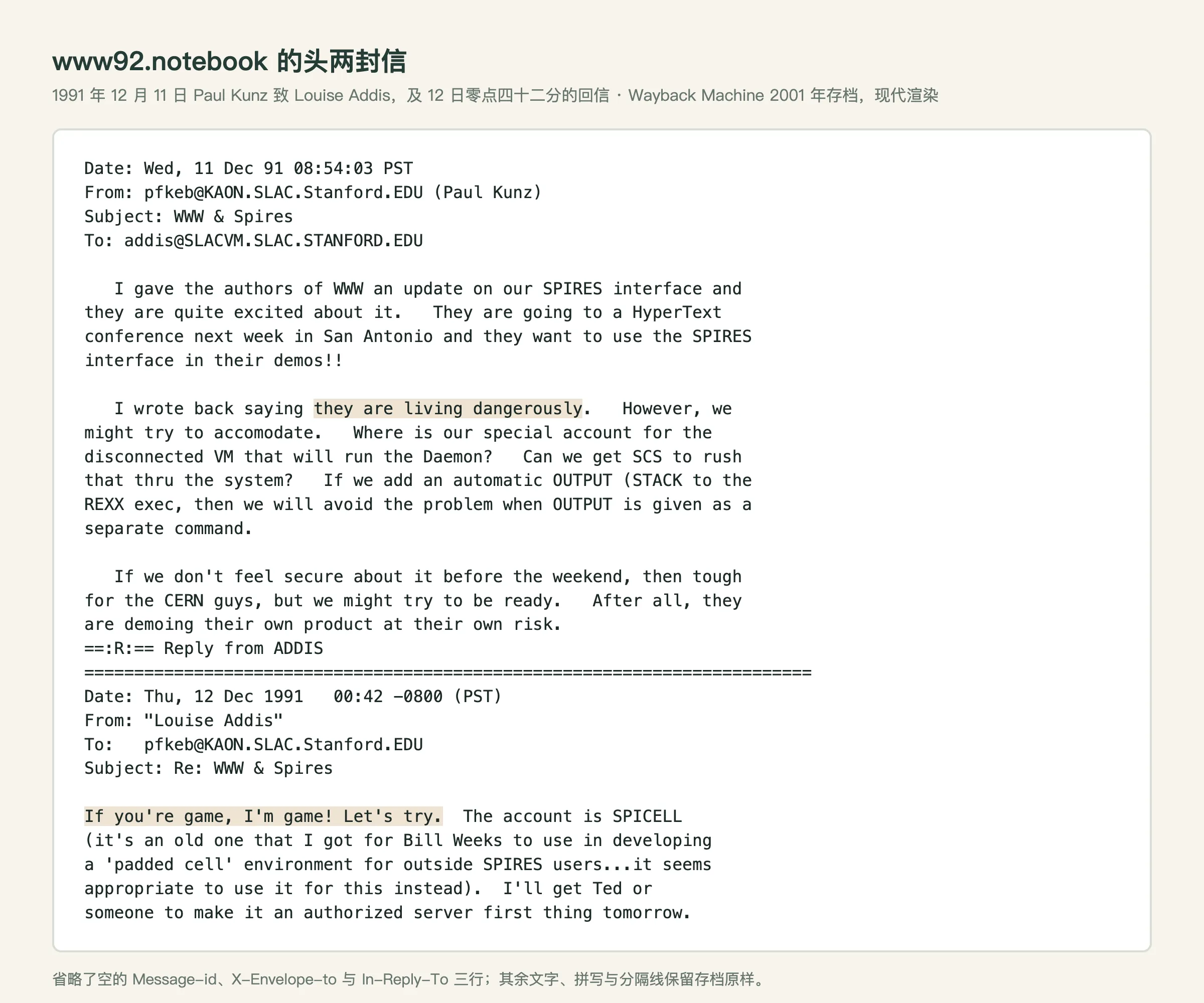
The first two letters as they appear in the mail log Addis kept. Text from the www92.notebook captured by the Wayback Machine on 17 December 2001, re-rendered in a monospaced font; three empty header lines omitted, spelling and separator lines as archived, two highlights added by this article. Not how it looked on a 1991 terminal. The letters are by Paul Kunz and Louise Addis and are excerpted here as historical sources.
I had meant to write about how the Web reached America by looking for the demonstrations and the publicity of the time. Then I read the mail log Addis kept, and changed my mind. The log is her inbox, from 11 December 1991 to 25 March 1992, three and a half months of letters and a few sets of minutes, and what it records is how a tool that arrived for free stayed alive inside one laboratory. Kunz went back to his own work the next day. From then on, whatever was in the letters landed on Addis.
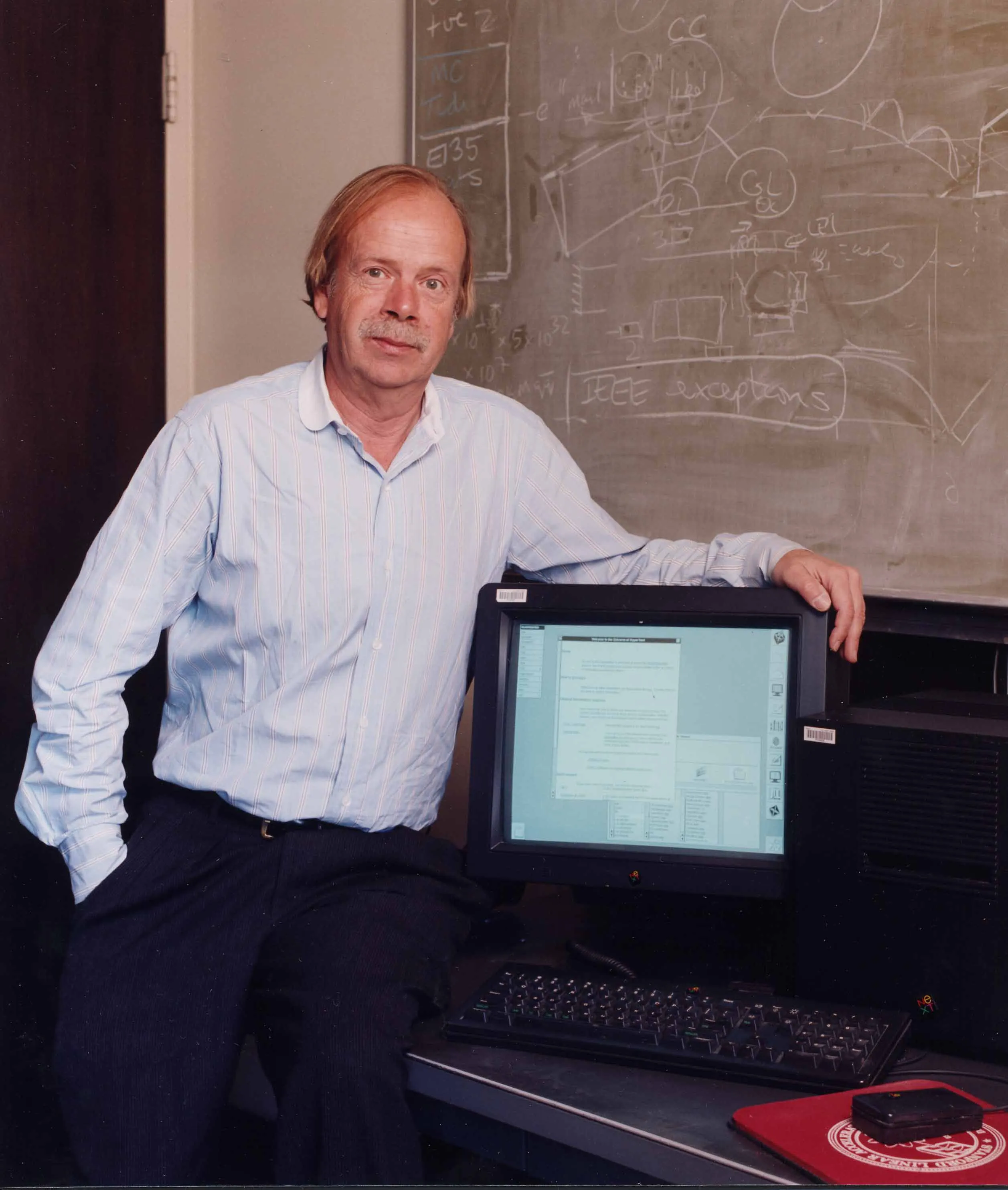
Paul Kunz with the NeXT once used to demonstrate early Web browsers at SLAC, photographed at SLAC in September 1998. This is a photograph from seven years later, not the scene of his return in 1991. Image: © SLAC National Accelerator Laboratory, archive source, unmodified; selected for the local draft, permission for public reproduction pending.
What the Library Had in Hand
Researchers in high-energy physics need to know promptly what their peers have written, and journals take a long time to publish; the version of a paper that circulates before publication is called a preprint. SPIRES-HEP at the SLAC library collected these, along with published journal articles, reports, and conference papers, and was run jointly by the SLAC library and the library at DESY, the German electron synchrotron laboratory. The 1992 edition of the Review of Particle Properties described it as holding more than 239,000 records as of January 1992, growing by nearly 20,000 a year, indexed by citations and topics as well as by the usual bibliographic fields. People without a SLAC account could search it too, through something called QSPIRES. BITNET was the academic network that had linked university mainframes before the Internet did; on it you sent your search as a message to the SLAC machine and the result appeared on your own screen, or you sent an e-mail of exactly one line and the result came back as mail. The manual’s example searches for 1991 papers with TOP in the title, with the condition written in the database’s own syntax and an output format specified afterwards. Today you type a few words into a browser and get results without knowing how the machine in the middle understood you; searching SPIRES in 1991, both of those were your job.4
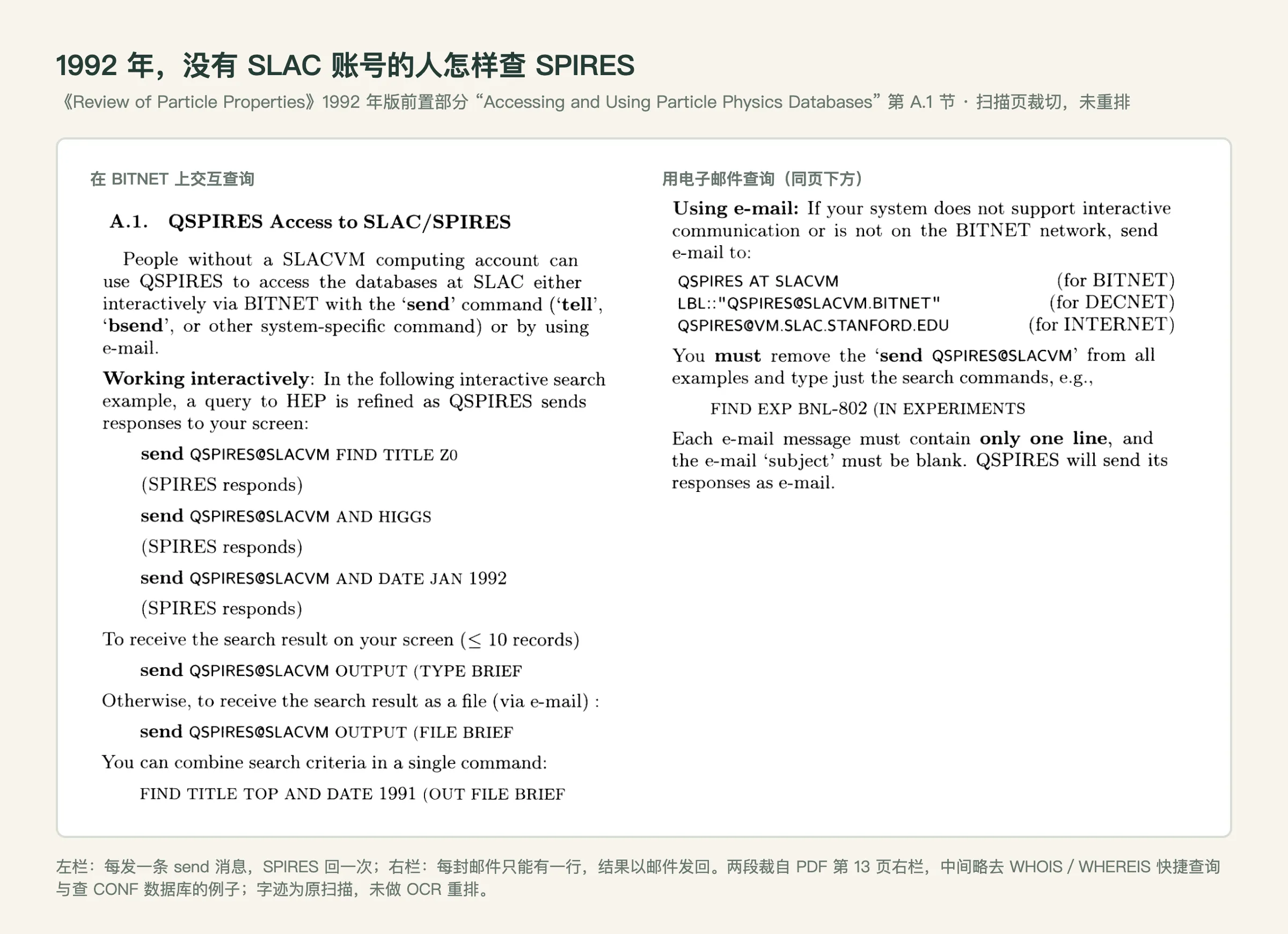
The 1992 Review of Particle Properties explaining how to use QSPIRES, section A.1 of its front matter. Left, interactive querying over BITNET; right, querying by e-mail from lower on the same page, one line per message. Cropped from the right column of page 13 of the Physical Review D volume 45 PDF; the WHOIS/WHEREIS shortcuts and the CONF database example between the two passages are omitted; the type is the original scan, not reset. © American Physical Society / Particle Data Group, excerpted here as a historical source. The section notes a revision of April 1992; it describes usage as of that date.
Addis had worked at the library since 1962, when it was still housed in a warehouse on the Stanford campus, and had been working on this database since about 1969. In a 2000 interview she recalled that researchers had originally queried SPIRES through BITNET’s interactive messages; once traffic moved to the Internet, the interactive messages were gone and only e-mail remained. “Researchers were less satisfied with the e-mail interface; they liked the instant response system better.” But the real trigger, she said, was something else. In 1989 and 1990 she had been helping the Superconducting Super Collider (SSC) project in Texas set up its library, and the librarian there wanted SPIRES-HEP inside a graphical interface; “SSC had funded the development of an X-Windows interface to do this,” X-Windows being the windowing system of Unix workstations. “I can still remember the day Paul Kunz appeared in my office after his trip to CERN. He showed me the Web and we started moving right away.” What she saw was a fast, cheap replacement. In today’s terms, SSC was writing a dedicated client for one database; what Kunz showed her was that database plugged into a general-purpose browser that could display anything.5
I think this explains why the first server outside Europe was attached to a library database. Writing an introduction page for a new browser tells people it exists; wiring in a database they already need to search gives them a reason to open it again and again. The library did not have to explain to physicists why they should look up papers, it happened to have an interface problem waiting for an answer, and somebody was already paying to solve that problem the expensive way.
“Even a real 3278 terminal is not as fast”
On the afternoon of 13 December, Berners-Lee announced the experimental Web service for SPIRES on the mailing list. He thanked Paul Kunz, Louise Addis, and Terry Hung, who had set up the server on the mainframe with Kunz, and warned that “It’s only just been put up, so don’t expect perfection.” The instructions were short: open the line mode browser, the one from the first article that only handles characters and runs on any terminal, follow the links from CERN’s home page, then type K FIND AUTHOR KUNZ to find records by an author named Kunz. “The ‘FIND’ is necessary at the moment, though it may change later.” At the end he quoted a letter Kunz had sent a few days earlier: “The SLAC Library maintainer of SPIRES databases, Louise Addis, is absolutely delighted. She will ask for a permanent VM service machine and finish off the polishing,” a service machine being an account on the mainframe dedicated to running a service. “Things are really moving now.”6
The quoted letter had one more paragraph. “We certainly have the impression,” Kunz wrote, “that accessing SPIRES from www on a UNIX machine is faster than using a terminal logged into SLACVM,” SLACVM being SLAC’s mainframe. “Even a real 3278 terminal is not as fast,” a 3278 being a display terminal wired straight to an IBM mainframe. “Actually, accessing CERNVM FIND via www seems faster than logging into cernvm and doing the same command as well,” FIND being the document index on CERN’s mainframe. I had expected the first users’ reasons to have something to do with links. Reading this, I found that the first benefit a physicist named was speed. He called it an impression; nobody had measured it. And a reader who walked from CERN’s page into SLAC’s database still had to learn the database’s own query syntax. Today’s search boxes and result pages hide this intermediate state easily: the new way in had been connected, and the old system’s habits were still showing through.6
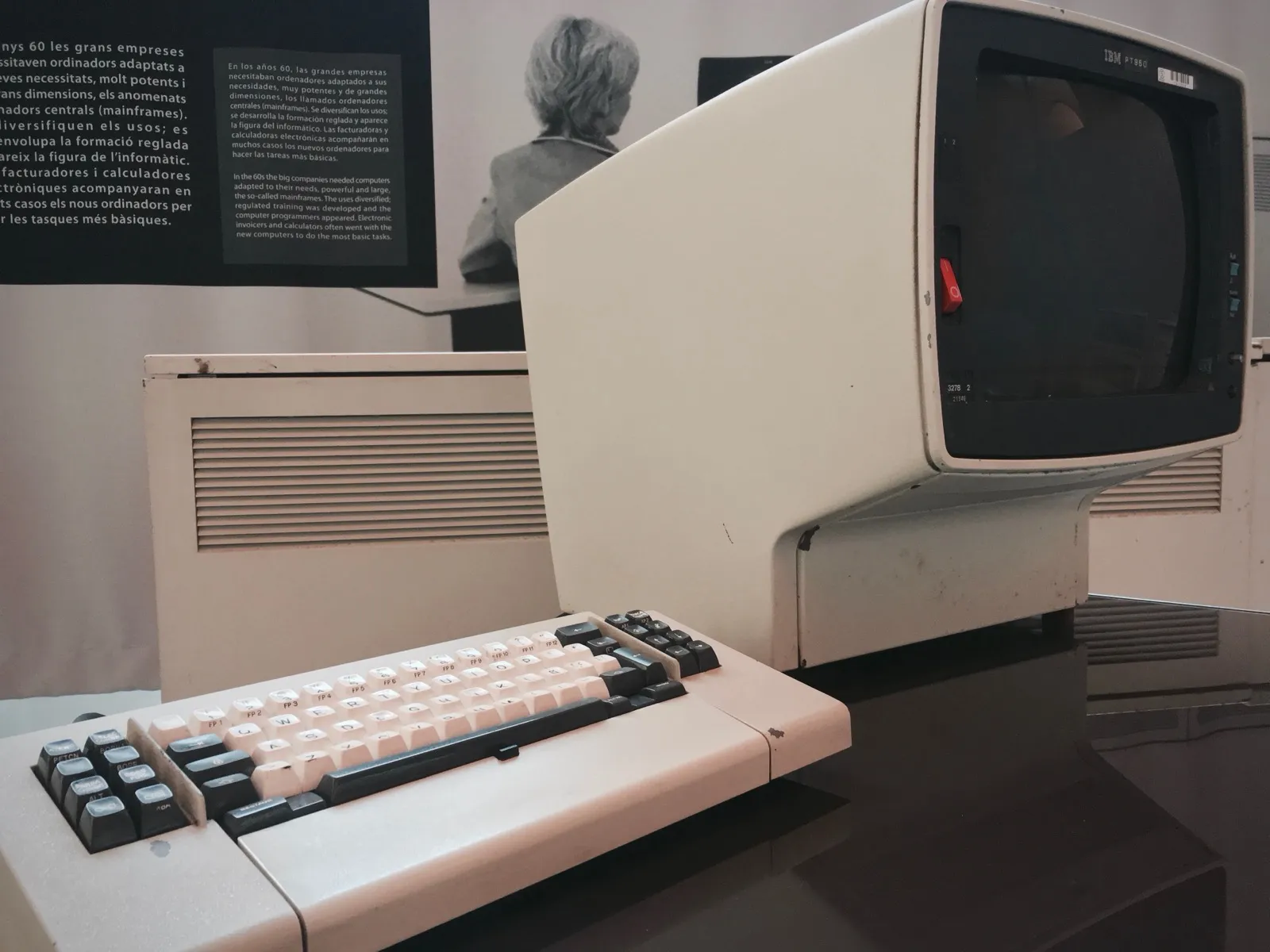
An IBM 3278 terminal, photographed in October 2016 at the Museu Nacional de la Ciència i de la Tècnica de Catalunya (MNACTEC) in Terrassa, Spain. The “real 3278 terminal” Kunz mentions was this kind of display terminal wired directly to a mainframe; this is a museum piece, not a SLAC machine, shown only so the reader can see the device. Photo: Marcin Wichary, source, CC BY 2.0, reduced in size only, not cropped or color-adjusted.

Addis later described how they divided the work. She got the accounts they needed. “Paul and Terry Hung set up the server on our mainframe. George Crane was able to easily extend remote SPIRES to talk to the new interface.” “And I was able to make the SPIRES-HEP database write HTML.” The history of the preprint service she wrote in the mid-1990s says the same.57
HTML at the time was an ordinary text file with tags in angle brackets marking headings, paragraphs, and lists. The tags came from SGML, a markup convention already in use in publishing and technical documentation; the one thing Berners-Lee added himself was the anchor, the tag that points a stretch of text at another address. CERN’s list of tags fitted on a page, and it told browsers to ignore any tag they did not recognize; the announcement of August 1991 said that making a small web was as simple as writing a few SGML files pointing to existing data. When Addis says she made the database “write HTML”, I take it to mean that the search results came out with these tags already on them.8 That is how a page of content appeared in front of a reader, plugged in behind a database that already existed. Most websites today have the same shape: the page is assembled on the fly, the data lives in another system, and a layer in between translates the request one way and the result back. In December 1991 that layer was a few REXX scripts, REXX being the scripting language of IBM mainframes.
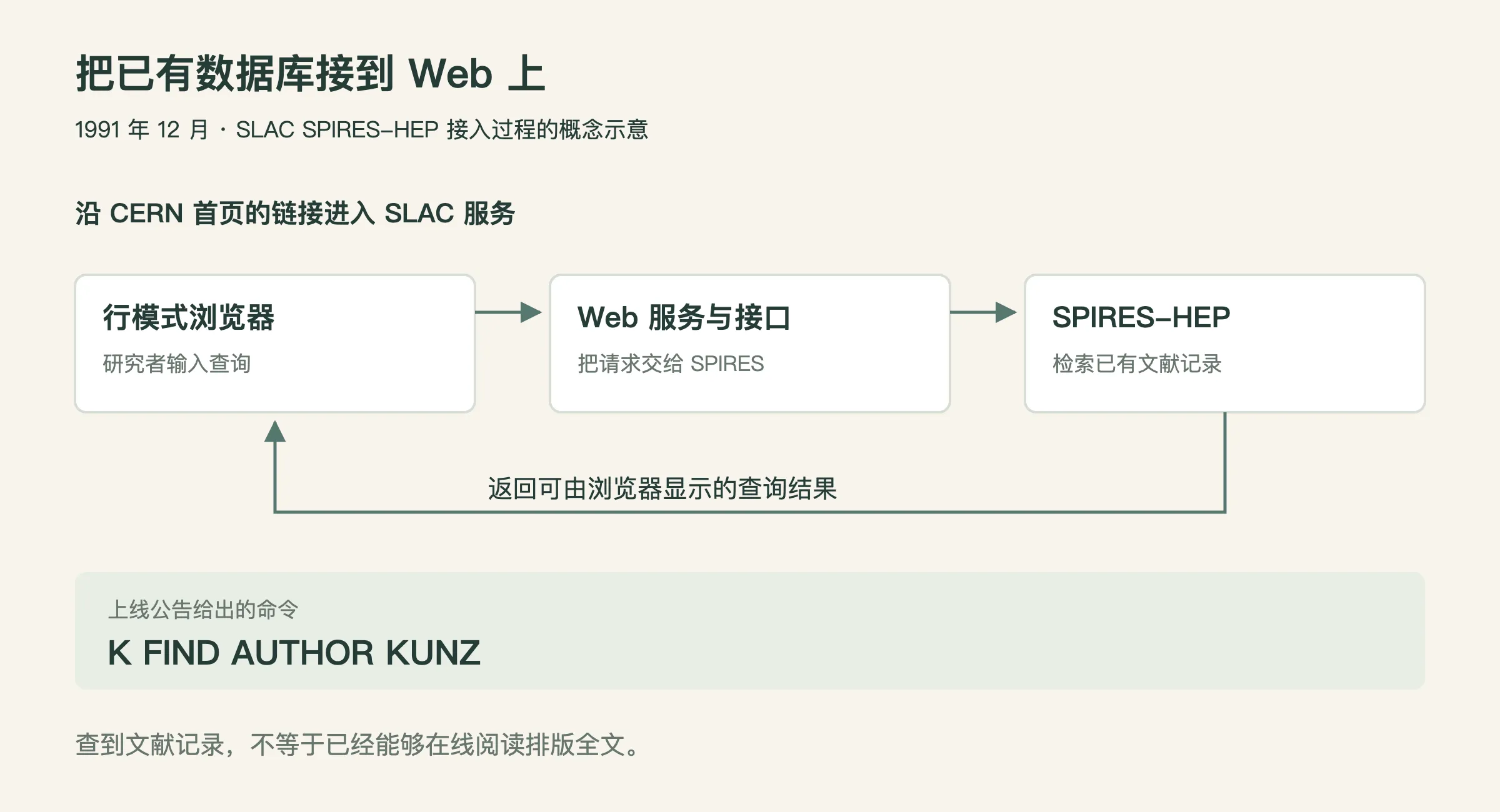
A conceptual diagram of SPIRES connected to the Web. Drawn for this article from the launch announcement of 13 December 1991 and Addis’s recollection of how the interface work was divided; the arrows summarize the flow of request and result, and results still pass back through the Web service and the interface. Not a contemporary interface or a complete protocol diagram.
Between finding a paper’s record and reading the paper on screen there was one more step. By Addis’s history, linking a database record to the TeX source on the Los Alamos server came in the summer of 1992, TeX being the typesetting format physicists write in; in her words, “This isn’t really full-text but it’s a lot better than nothing.” Displaying and printing the typeset text with its equations had to wait for the spring of 1993, when the library bought a NeXT and a 1.3 gigabyte disk. What went live in December 1991 was a way in to bibliographic records.7
Seven Records Short
Once the server was running, the first thing to break was the server. On 11 February 1992 Kunz wrote that “The WWW server is still not running”; the daemon could not bind to its port, he pasted the error messages as they came, and added: “I have no clue on what to do about it.” Five days later Tony Johnson, a physicist, remembered a list of “bugs” in the SPIRES interface that Berners-Lee had sent him earlier, and forwarded it to the group. The first item said the front page should describe the bounds of the index: “what material will be in it, what won’t. If its everything in HEP, say so, if it isn’t, say so.” Then Berners-Lee added, “I am not one to talk: We haven’t done that with the XFIND index but we certainly ought to.” Another item noted that the line mode browser had a find command of its own, so that to search SPIRES one had to type find find title tau and date 1980, “which is not intuitive!” The rest were a broken help link and extra spaces at the ends of lines.1
On 25 February an outside user reported the same problems on the public list. Willem van Leeuwen of NIKHEF, the Dutch high-energy physics institute, wrote that “When browsing the SPIRES database one has to type find twice.” There was a more troublesome thing. Searching for the author Holthuizen, “there should be 111 references, only 104 are shown.” Berners-Lee replied that these should be fixed on the server side, but he had no firm explanation for the missing entries, only a guess: “Perhaps its in lines.”9
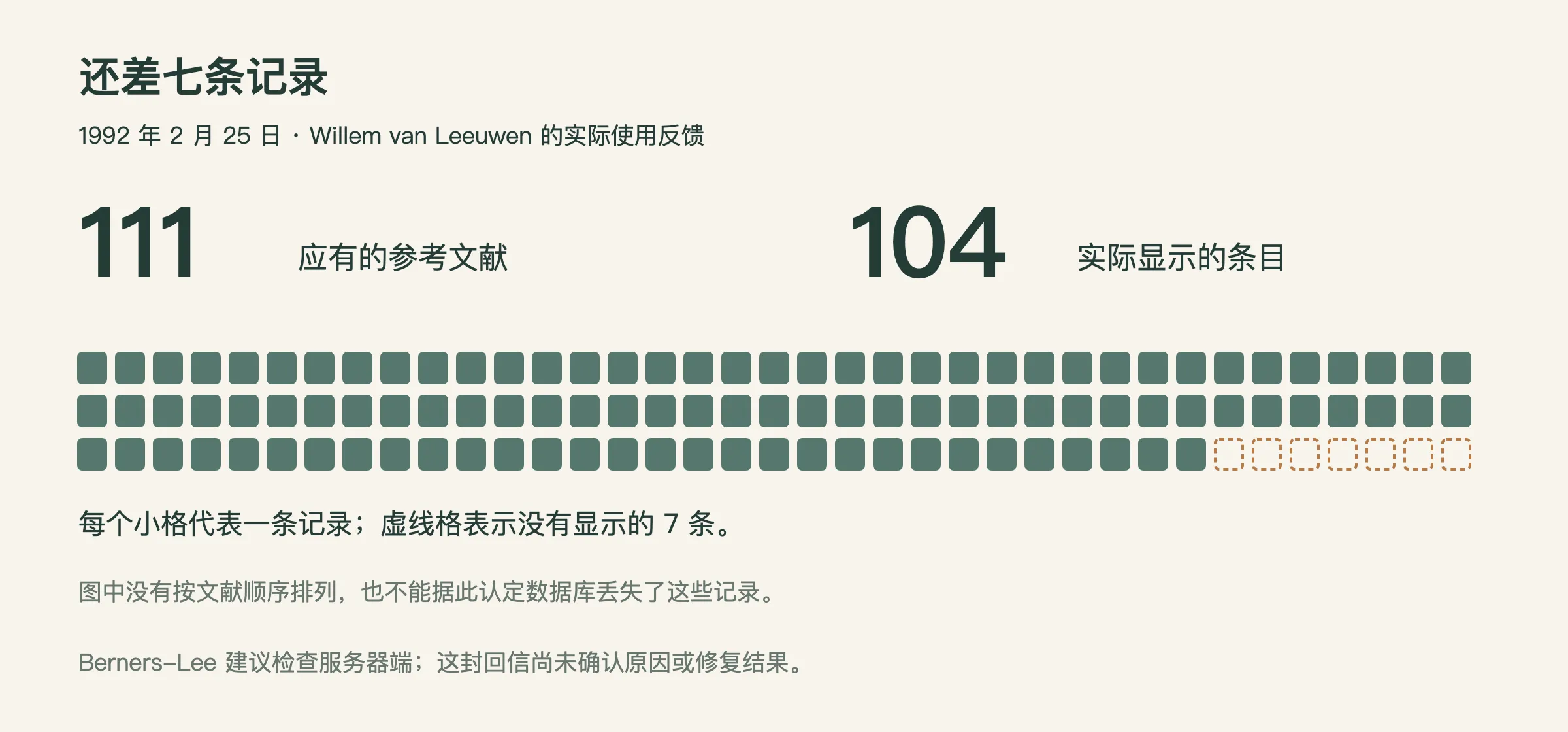
A count comparison drawn for this article from the mail of 25 February 1992: the user reported 111 expected, 104 shown. The cells stand for counts only, not for the order of the references; this is not the original result page, and it does not show that the database had dropped seven records.
The same day Berners-Lee sent van Leeuwen a private reply, copied to SLAC, under the subject “spires - confuses most people.” “You are not the first to notice this problem with the SPIRES server,” it began. “The problem is that the guys who originally got it going in a short space of time are not responsible for maintaining it or making little fixes like this.” Then he turned to Kunz: “Could we have a contact name for the SPIRES server, please?” Software projects today call this role the maintainer; SLAC in February 1992 did not have the word, only the question. As for the double find, the browser had changed, he explained. The new version took FIND as a command of its own and sent only the last two words to the server; a line of REXX on the server side would put the word back. Kunz forwarded the letter to Addis and Crane: “This explains why the SPIRES server doesn’t work from CERNVM anymore. But I think you have already figured it out.”10
Seen from the user’s side, seven records that did not show up mattered far more than what protocol the server used. Search for an author’s papers, come up a few short, and you may have missed the very one you were looking for; when the text on the terminal comes out jumbled, you also have to work out whether the content is wrong or the display is. The Web had got two systems talking. The maintainers still had to check, item by item, whether what reached the reader was complete and readable. As for the question Berners-Lee asked, who would look after it next, SLAC had by then held two meetings about it.
“Row and build the boat as you go”
The meeting on 5 February was called by Addis. Her account in 2000: “By February 1992, I had twisted enough arms to start an ad hoc Web development and support group”; the minutes call it the WWW Working Wizards. Present were Addis, Kunz, Johnson, Crane, and Bebo White. The minutes open by recording that Kunz “has imported the WWW (WorldWideWeb) software to SLAC from CERN,” and that the SPIRES interface was “a quick and dirty gateway which Paul installed on SLACVM for demonstration purposes,” a gateway being a program that translates requests from one side to the other. Having “demonstrated the potential of WWW at SLAC,” he “wishes to transfer the maintenance and polishing to other hands.” He handed over a list of files, C programs, what the minutes call SGML, and REXX execs, in seven parts, and walked the group through the code. The minutes end on a note: “It’s not clear how much help can be expected from SCS folk because of press of other tasks. They’ll try to get that clarified.”51
The same minutes record how far the browser had spread inside SLAC. Kunz had installed it on the Unix cluster called Unixhub and on Group B’s NeXT cluster; Bebo White on the IBM mainframe SLACVM; Johnson on SLACVX, which ran DEC’s VMS. CERN’s project newsletter of 24 January relayed Kunz’s word that “the line mode browser is installed on all unix systems at SLAC.” How many machines it was installed on and how many people used it are two different numbers, the ones product people today call installs and active users. They wanted the two numbers separated in 1992; they just had no way to count. One item on the to-do list was to “identify individual users (rather than just their IP addresses),” for iterative searching and “for possible recording of user statistics.”111
Two weeks later there was an answer. In her reminder for the meeting of 19 February, Addis recapped the previous week’s decisions: the computing division “says ‘yes’ to time commitments for WWW”; White and Johnson would read the interface’s C code and consider recoding it in REXX for maintainability; Crane would fix and enhance the search interface to SPIRES; Mark Barnett would estimate the workload of maintaining WWW on three platforms; Joan Winters would explore CERN’s WWW menus with an eye to SLAC’s own, “when and if WWW is announced.” The SLAC chronology goes on to record that in July Johnson built the laboratory’s central entry page, and in the autumn released a graphical browser of his own, MidasWWW.12
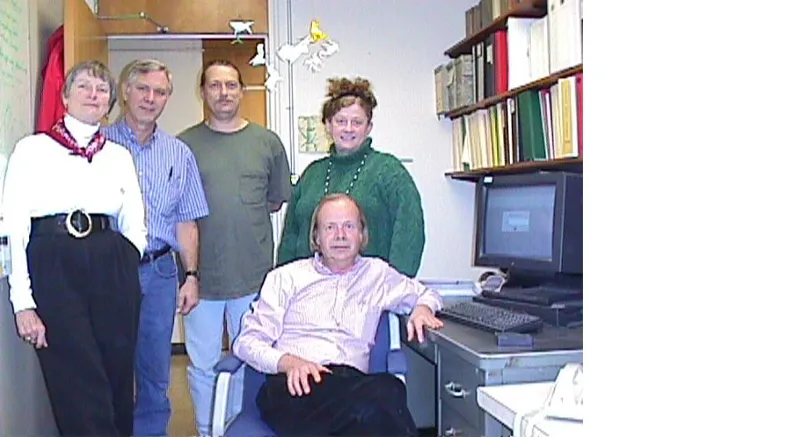
Some of the WWW Wizards in Paul Kunz’s office at SLAC, February 2000. Left to right: Louise Addis, George Crane, Tony Johnson, Joan Winters; seated, Paul Kunz. A photograph from eight years later, not the scene of the group’s founding in 1992. Image: © SLAC National Accelerator Laboratory, date source and order of people, original unmodified; selected for the local draft, permission for public reproduction pending.
What the chronology does not record is March. On the morning of 11 March, Barnett wrote to Addis, copying the group: “It doesn’t make sense for me to commit to continuing responsibilities in the project, since I am having trouble meeting prior commitments.” His take on the project: it “is capable of providing a useful service with a limited local effort,” but “It appears to be an infinite sink”; to survive it needed “a set of limited (i.e., minimal) goals” and “a coordinator (not me) with the time and interest to make it work.” The letter was started at 7:48; a postscript says it was 11:07 when he finished. “I appreciate the ‘coordinator’ offer, but it’s not a good idea.” The next day Addis wrote to Winters that most people in the research division were in the same state and that her own time was hasty at best. What she wanted was a menu that “doesn’t confuse the heck out of a sane person and gives an impatient physicist instant access to a function he/she already understands.” In a postscript she passed on Crane’s analogy: “sometimes you just have to row and build the boat as you go.” Winters realized on her drive in the next morning that she had not replied, and wrote a few lines: “I will try to help build the www boat as we row. Though my own experience is that such boats usually leak. Still, sometimes it’s necessary.”1
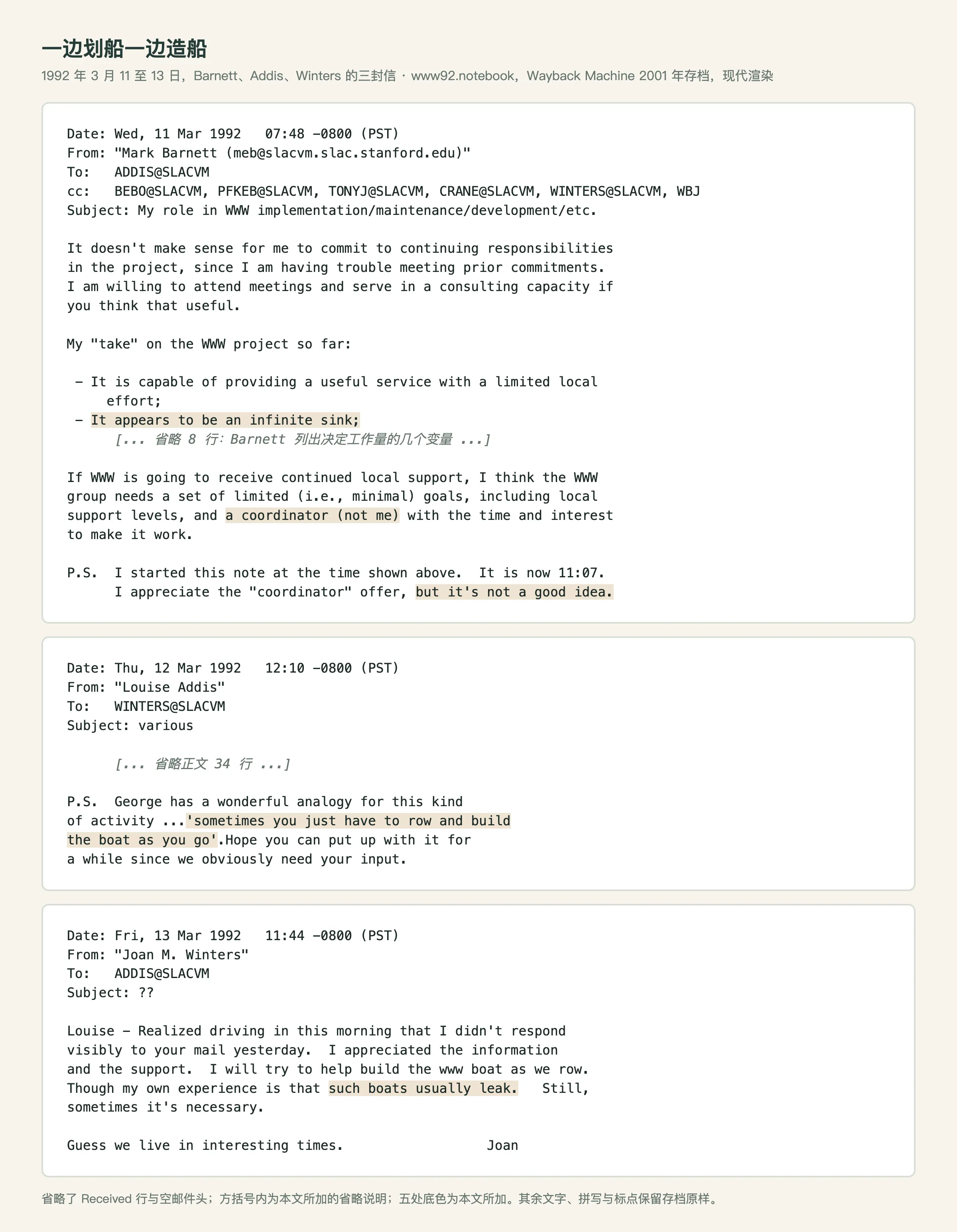
Barnett’s letter of 11 March, the postscript of Addis’s letter to Winters of the 12th, and Winters’s reply of the 13th, as they appear in www92.notebook. Text from the Wayback Machine capture of 17 December 2001, re-rendered in a monospaced font; Received lines and empty headers omitted, the eight-line list of variables in Barnett’s letter and the body of Addis’s letter marked as omitted in square brackets, five highlights added by this article. Not how it looked on a 1992 terminal. The letters are by Mark Barnett, Louise Addis, and Joan Winters and are excerpted here as historical sources.
These letters are what make me willing to put Addis at the center of the story. She wrote no browser and no server. What she did was say, at one in the morning on 13 December, “I’ll start trying to get George interested”; pull five or six people into her office in February and send everyone a record of who would do what; and when someone dropped out in March, write to the next person. The author of the 2000 interview notes that on the phone Addis first laughed and disclaimed responsibility for bringing the Web to America, then said the history of the Web is “rather like Rashomon,” the same events told differently by everyone. Asked whether she had imagined what the Web would become, she said no: “I was just hoping it would survive at SLAC.” None of this was anyone’s job at first. “None of us got raises or payment for this work. We did some of it on our own time,” and for a long while the Web carried the label of unsupported software. She added that it was fun: “I hope my colleagues would agree.” Anyone who has maintained an internal tool at a company will recognize the situation. The browser could be fetched from CERN for free. The person to look after it had to be found locally.51
“They wanted to get to our database”
The Dutchman who reported 111 becoming 104 also wrote down how he had come to use the Web. On 26 February Kunz forwarded to Addis a post from the newsgroup of high-energy physics Unix users, in case she had missed it; a newsgroup is one of Usenet’s public discussion areas, sorted by topic. In November 1991, van Leeuwen wrote, he had installed a WWW browser at NIKHEF to read the CERN library’s documentation in XFIND; “The enthusiasm about WWW at NIKHEF grew when the SPIRES preprint database at SLAC became available via WWW.” This month he had installed a server on a Sun, its contents still rudimentary, but what he really wanted to say was that it was “EXTREMELY simple to install a server and to make information accessible to WWW on a UNIX system,” and he would “humbly suggest” using it to find out “Who is working Where on What.” He signed himself Wwwillem. In the copy that reached Addis, someone had put a row of marks under “the SPIRES preprint database at SLAC”.12
The next day Barnett sent her a message that was all subject line and no body: “In case you haven’t, GIME BOEHEIM 192 then GOPHER,” that is, mount a colleague’s disk on SLACVM and type GOPHER. Gopher was a menu system from the University of Minnesota, browsed level by level; it was already installed on SLACVM, the same mainframe as the SPIRES gateway. The log ends on 25 March with a notice from Berners-Lee to the list of interested parties: a new minor release of the server code, available by anonymous FTP from CERN, downloadable without an account; it now included a gateway to WAIS, another networked full-text search system of the day, and would compile under older C compilers. In other words, another version for somebody to install. Software today updates itself; in 1992 each new version was a letter and an FTP address, and whether it got installed depended on whether anyone was there.113
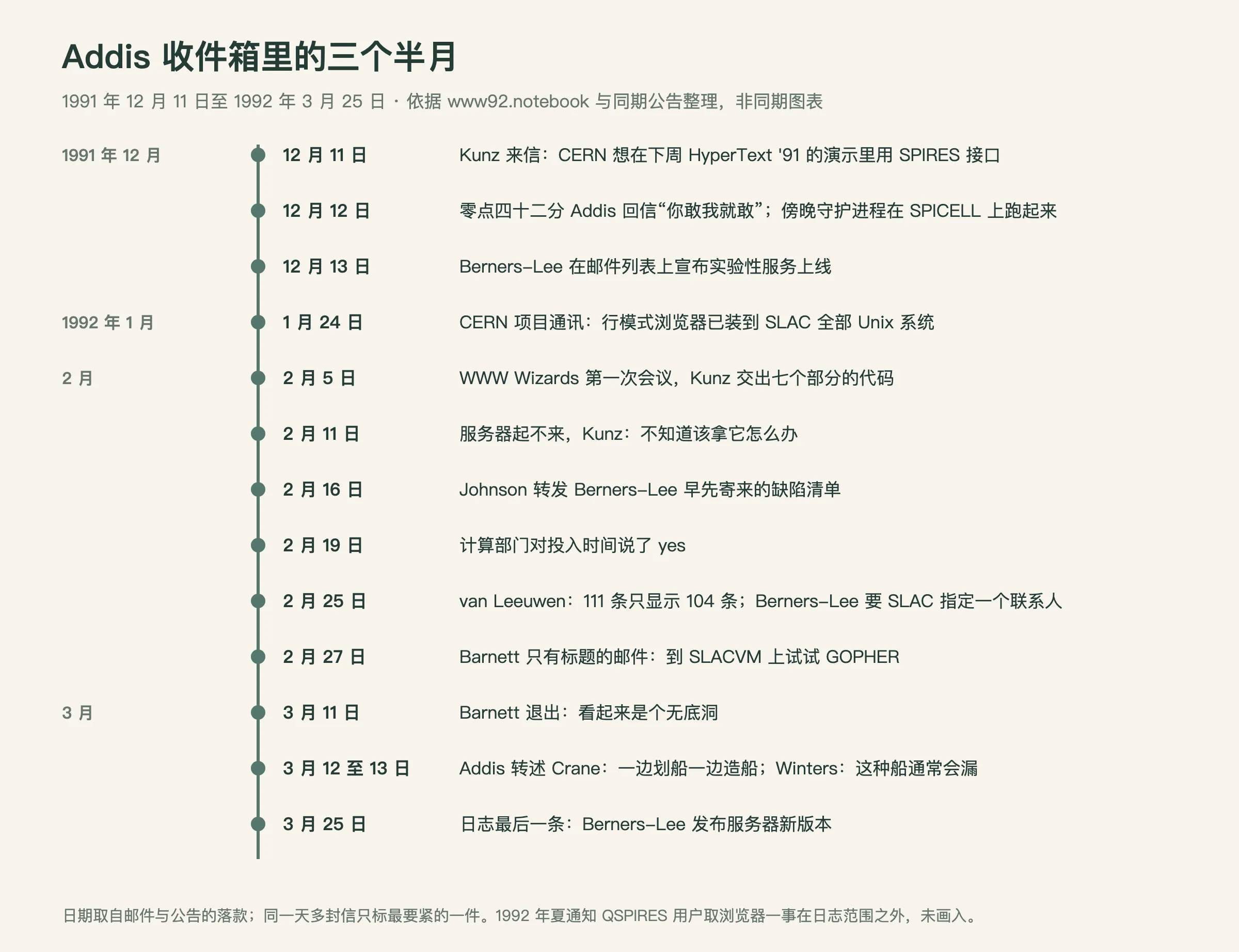
The three and a half months the log covers. Dates are taken from the letters and announcements; where several letters fall on one day, only the most important is marked. Drawn for this article from www92.notebook and contemporary announcements; not a contemporary chart. The notice to users about fetching the browser in the summer of 1992 falls outside the log and is not shown.
That summer the library did something Addis later mentioned in a single sentence. Her history says that “QSPIRES users are encouraged to FTP the free browser from CERN and change to WWW and some do.” In 2000 she was more specific: “When we notified our registered users about how to get a free browser from Tim at CERN, many did right away. They wanted to get to our database, so they were really motivated to get that browser and get on the Web.” She did not say how many “many” was; the history says only “some”. Installing a browser to get into a database is the same motion as installing an app today to use a service. My guess is that most of the first people to open a browser were brought there by a database they already needed to search.75
Addis retired from SLAC in 1994. The letters were later saved as a plain text file in her personal directory, named www92.notebook. The Internet Archive captured it once, in December 2001, and that capture is what can be read today.51
Footnotes
-
Louise Addis’s log of internal SLAC mail,
www92.notebook, covering mail and minutes from 11 December 1991 to 25 March 1992, originally in her SLAC personal directory, now preserved in the Wayback Machine capture of 17 December 2001. A contemporary primary source, but limited to mail Addis sent, received, or was copied on; the minutes are hers. Used here for the Kunz–Addis exchange of 11–13 December 1991; the minutes of 5 February 1992; the server failure of 11 February; the Berners-Lee bug list forwarded by Johnson on 16 February (the list itself is undated and is described only as received when Johnson first contacted Berners-Lee); the meeting reminder of 19 February; Barnett’s Gopher mail of 27 February (subject line only, no body); Barnett’s withdrawal of 11 March; Addis’s letter and postscript to Winters of 12 March; Winters’s reply of 13 March; and Berners-Lee’s notice of a new server release on 25 March, the last entry. Quotations in the text are verbatim from the log; see 1991–1992 SLAC WWW 工作笔记本(Addis). The single-page minutes of 5 February 1992 and the correspondence with Terry Hung listed separately on the SLAC archives page are dead links with no archived copy. ↩ ↩2 ↩3 ↩4 ↩5 ↩6 ↩7 ↩8 ↩9 ↩10 -
SLAC Archives, History and Records Office, Early Web Chronology and Documents, 1991–1994. An institutional chronology compiled after the fact, used here for Kunz’s return, the claim of “first outside Europe,” and the dates of the 1992 entry page and browser; the 12 December 1991 launch is separately supported by contemporary mail, see the notebook note. The chronology’s presenter for the January 1992 conference in France disagrees with the contemporary newsletter and is not used. ↩ ↩2
-
ACM Hypertext ‘91, 15–18 December 1991, San Antonio. The W3C’s A Little History of the World Wide Web records under December 1991: “Presented poster and demonstration at Hypertext’91”; CERN’s document server holds a photograph of the demonstration dated 17 December. The reviewer’s concern comes from a 2015 comment by the reviewer Mark Frisse on Mike Caulfield’s blog: the decision was made by a committee, the community was then arguing about whether links in an authoring system had to be bidirectional, and “if I remember correctly, Tim had a demo and really rocked the house.” This is a recollection more than twenty years later; it is used only to show what the reviewers cared about, not to establish the sole reason for rejection. The proceedings’ table of contents is at DBLP: no entry for the Web, and Pamela Samuelson and Robert Glushko’s analysis of Xanadu on pages 39–50. Evidence is collected in Hypertext ‘91 上的 WWW 论文待遇与演示. ↩
-
Particle Data Group, Review of Particle Properties, Physical Review D vol. 45, 1992; front matter “Accessing and Using Particle Physics Databases,” PDF pages 13–15, marked as revised April 1992. The record count, the joint operation, the interactive and e-mail forms of QSPIRES, and the free use and node registration are taken from that section. The full PDF was checked. ↩
-
Melissa Henderson, First Monday Interviews: Louise Addis, May 2000. A retrospective interview. Used here for 1962, 1994, and about 1969; the old query methods; the SSC graphical interface; the day Kunz appeared in her office; the division of work; “twisted enough arms”; “just hoping it would survive”; volunteer labour and “it was fun”; and the notice to users about getting the browser. The laughing disclaimer and the Rashomon comparison come from Henderson’s introduction, her account of the phone conversation, not the interview proper. The interview’s “nearly five thousand registered users in forty countries” is a figure from 2000 and is not used as a 1991 count. ↩ ↩2 ↩3 ↩4 ↩5 ↩6
-
Tim Berners-Lee, WWW to SPIRES on SLACVM — Experimental, 13 December 1991. The announcement keeps the query command and quotes Kunz’s letter of a few days before; “absolutely delighted,” “Things are really moving now,” and the sentences about speed are from the quoted part. Requesting a permanent VM service machine is a plan in the letter, not a completed step. Kunz’s own words are “we certainly have the impression”; the speed claim is an impression, not a measurement. ↩ ↩2
-
Louise Addis, Brief and Biased History of Preprint and Database Activities at the SLAC Library, 1962–1994, written around 1994 with additions between 1997 and 2002. Addis’s own retrospective account, of the same kind as the 2000 interview; used here for the entries of December 1991, summer 1992, and spring 1993, to keep three moments apart, bibliographic search, links to TeX source, and the later full-text service, without crediting later conveniences to the launch of December 1991. ↩ ↩2 ↩3
-
The form of HTML is taken from MarkUp.html (“The hypertext mark-up language is an SGML format”; “WWW parsers should ignore tags which they do not understand”; edited by Dan Connolly) and Tags.html (the tag list: TITLE, A, H1 to H6, P, UL, LI, and others) in the CERN hypertext snapshot of 3 November 1992. That is the late-1992 version; the tag set of December 1991 can only have been smaller. That P, H1 to H6, UL, and LI came from SGML while A HREF was Berners-Lee’s addition follows Raggett et al., Raggett on HTML 4 (Addison Wesley Longman, 1998), chapter 2, a retrospective account. “A few SGML files which point to your existing data” is from the project summary of August 1991, see 1991 WorldWideWeb Internet Announcement; a copy is also in Addis’s mail log. Addis’s words are “I was able to make the SPIRES-HEP database write HTML,” see the addis note; how the output was produced she does not say, and the reading in the text is this article’s inference. ↩
-
Tim Berners-Lee, Browser append to file, and SPIRES server, 25 February 1992. The reply preserves Willem van Leeuwen’s original report; 111 and 104 are the user’s expected and displayed counts. Berners-Lee’s explanation in terms of a line count is a guess, and this letter does not show that the defect was fixed. ↩
-
Tim Berners-Lee to Willem van Leeuwen, subject “spires - confuses most people.”, 25 February 1992, copied to Kunz, Hung, and CERN’s www mailbox; forwarded by Kunz to Addis and Crane the same day. See the mail log cited in the notebook note. This letter and the public www-talk reply above are two letters of the same day; used here for “not responsible for maintaining it,” the request for a contact name, and the explanation of the double
find. ↩ -
Tim Berners-Lee, WorldWideWeb news: New software includes Gopher, News, Telnet access, 24 January 1992. The extent of installation at SLAC is the newsletter’s relaying of Kunz’s report; the specific machines are in the minutes of 5 February. The newsletter records an enthusiastic reception for the HyperText ‘91 demonstration and names Jean-François Groff as the presenter at the January conference in France. ↩
-
Willem van Leeuwen’s post to the hepnet.hepix newsgroup, forwarded by Paul Kunz to Addis on 26 February 1992; see the mail log cited in the notebook note. The original post was not located separately; only the passages quoted in the forward are used: the purpose of installing a browser at NIKHEF in November 1991, the rise in enthusiasm after SPIRES went online, the server installed on a Sun that month, the words “EXTREMELY simple” and “humbly suggest,” and the signature Wwwillem. A row of marks under “SPIRES preprint database at SLAC” appears in the forward; this article does not say who added it. ↩
-
F. Anklesaria et al., RFC 1436, The Internet Gopher Protocol, March 1993, all authors at the University of Minnesota. A specification from 1993, used here only for Gopher’s origin and its menu-driven, level-by-level form, not to infer the version or use of the client on SLAC’s mainframe in February 1992. ↩