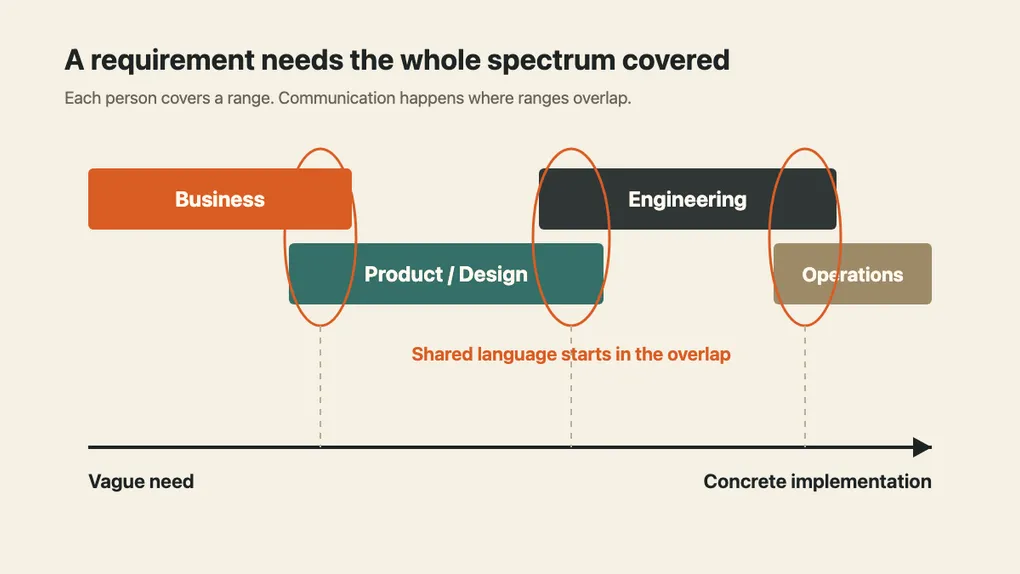
The Spectrum
“I’m so tired of tracking every order by hand.”
That may describe a real pain, but it is not yet a requirement, much less something an engineer can implement. We do not know what starts the tracking process, where the information lives, which rules and exceptions apply, what the system should do, what happens when it is wrong, or who is responsible. There is a long distance between a vague complaint and a product that works. I call that distance the spectrum.
At the left end of the spectrum are human frustrations, problems, and desires. At the right end are concrete systems and implementations. Product, design, engineering, QA, and operations sit at different places in between. Each person can understand and handle a range, but few people cover the entire spectrum.
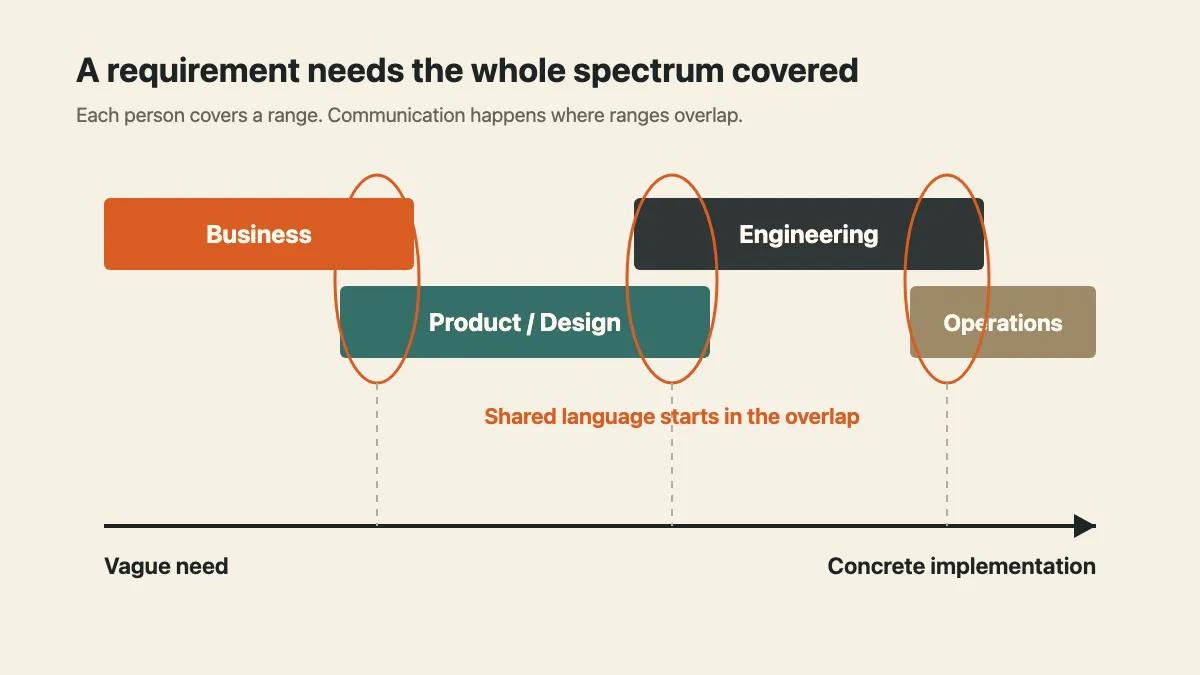
Coverage must be continuous. Communication happens in the overlap.
Coverage and overlap
For a product to ship, every part of the spectrum needs coverage. If no one can handle a section in the middle, the requirement never reaches implementation. Adjacent people also need some overlap. The business side may be talking about a real workflow while engineering is talking about databases, APIs, and job scheduling. Both sides may be right, but without shared language, knowledge, or artifacts, sitting in the same meeting does not mean they are communicating.
Overlap is not sloppy ownership or organizational redundancy. It is what lets information move. A product manager needs to understand the user and still be able to discuss the same product definition with design and engineering. An engineer does not need to become the product manager, but does need to understand why the requirement exists. Each person covers a range; adjacent ranges connect; the spectrum remains unbroken.
Moving from a vague need to a concrete implementation is not one translation. It is a chain of deliverables. A user problem becomes a workflow. The workflow becomes a product definition. The product definition becomes a system model, and only then does it become code and a running product. Every handoff preserves some of the original meaning and loses some of it.
Imagine giving each handoff a score between zero and one. This is not a performance rating for a team. It describes how much of what mattered in the previous stage was understood and carried into the next one. The final outcome comes from these effects compounding, not from averaging everyone’s work. Every step can look respectable on its own while surprisingly little survives the full journey.
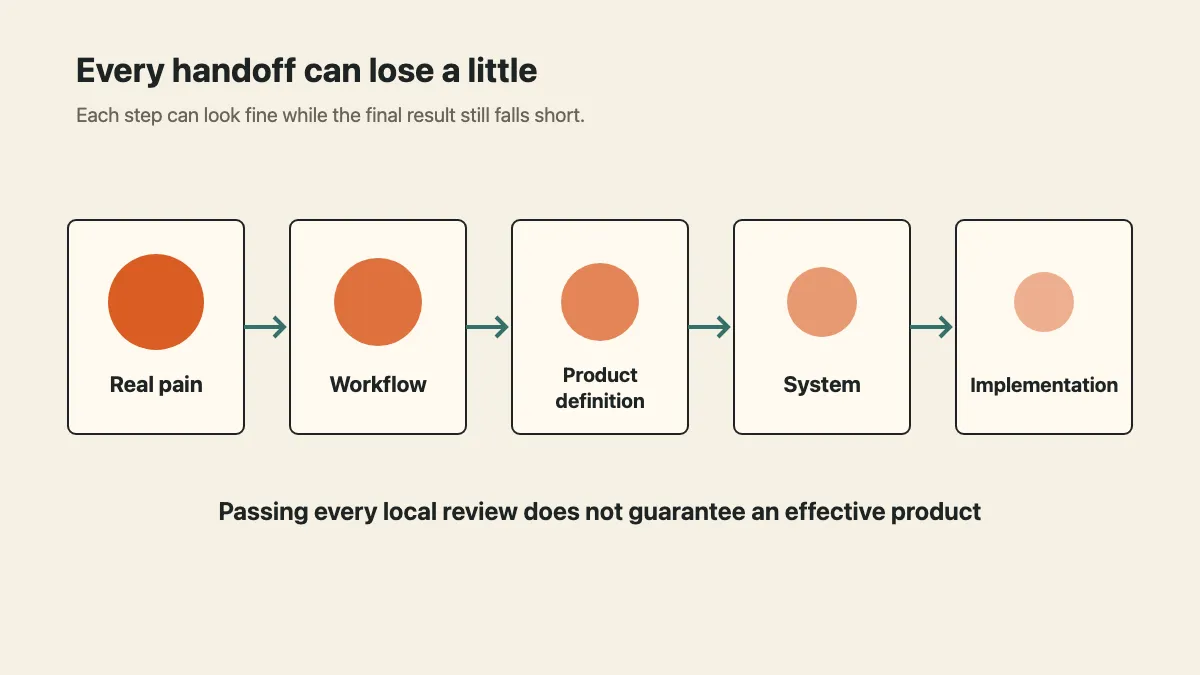
Passing every local review does not guarantee an effective product.
This is how many projects fail. Everyone completes their part, every local deliverable gets approved, and the product still does not create the expected result. One excellent stage cannot restore what another stage has already lost. If any stage fails completely, good work before and after it cannot save the outcome.
What sets the ceiling for one part of the spectrum?
Several people may work around the same position. I make one deliberate simplification in this model: the ceiling in that area is set not by the average ability of everyone nearby, but by the strongest ability among the people who are actually involved.
This is not an argument for hero culture. Other people provide coverage and overlap, allowing information to reach this point and move beyond it. The strongest specialist nearby determines how well that particular work can be done. A new team member changes the result in one of two ways: they raise the ceiling in a region, or they widen the coverage, fill a gap, and connect ranges that did not previously meet. Adding headcount by itself does neither.
AI changed the shape of the spectrum
The most visible change after introducing AI is that the spectrum becomes shorter. A single requirement used to pass through documents, process diagrams, interaction mockups, technical designs, and code before it became a working prototype. Some of those deliverables can now be combined or produced in one continuous conversation. The real problem has not become simpler. What has become shorter is the production distance between the problem and its implementation. Fewer handoffs also mean fewer opportunities to lose information.
AI changes the shape of each person’s ability as well. Product people can build prototypes directly. Engineers can move closer to user research and product definition. Operations teams can make working internal tools themselves. A person’s range expands in both directions, while AI also makes them faster and more capable in areas they already know. A path that once required several people working in relay may now be mostly covered by one person.
That does not make every position on the spectrum equally easy. AI gives people a broad layer of baseline capability. It can take them to places they could not previously reach, but it does not guarantee that they can perform well once they get there. Medical judgment, safety systems, complex architecture, and brand design may still need to be nearly perfect. Those positions still need specialists. Experience, taste, professional judgment, and the ability to bear responsibility determine the peak. AI expands the range of action, but it also makes genuine depth easier to see.
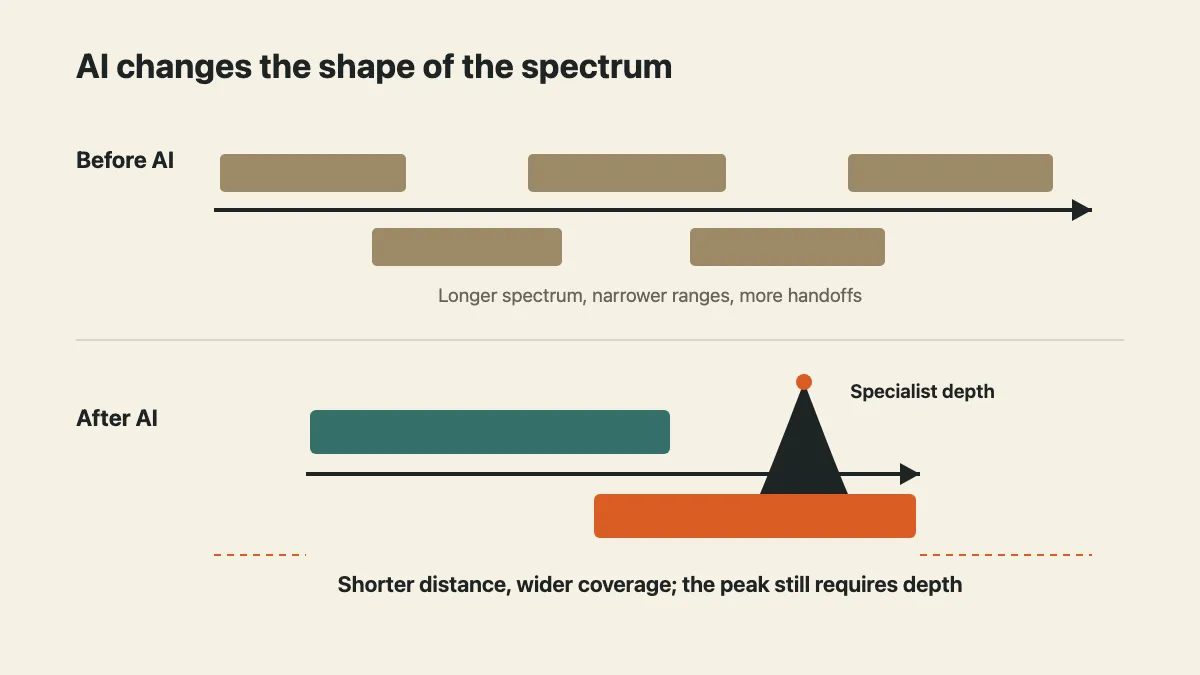
The distance gets shorter and individual coverage gets wider. The peak still requires specialist depth.
Go deep or go wide
Even without AI, the model suggests two paths for personal growth. One is to go deeper near a particular deliverable and raise the peak of your ability there. You learn to see problems others miss and develop a much sharper sense of what “done well” actually means. Eventually, you become the strongest person in that part of the spectrum.
The other path is to widen your range. You learn the language, judgment, and deliverables of adjacent roles. This creates more overlap, reduces translation and handoffs, and lets you move a vague problem much closer to a result on your own. The value is not that you know a little about everything. It is that you can connect sections that used to be disconnected.
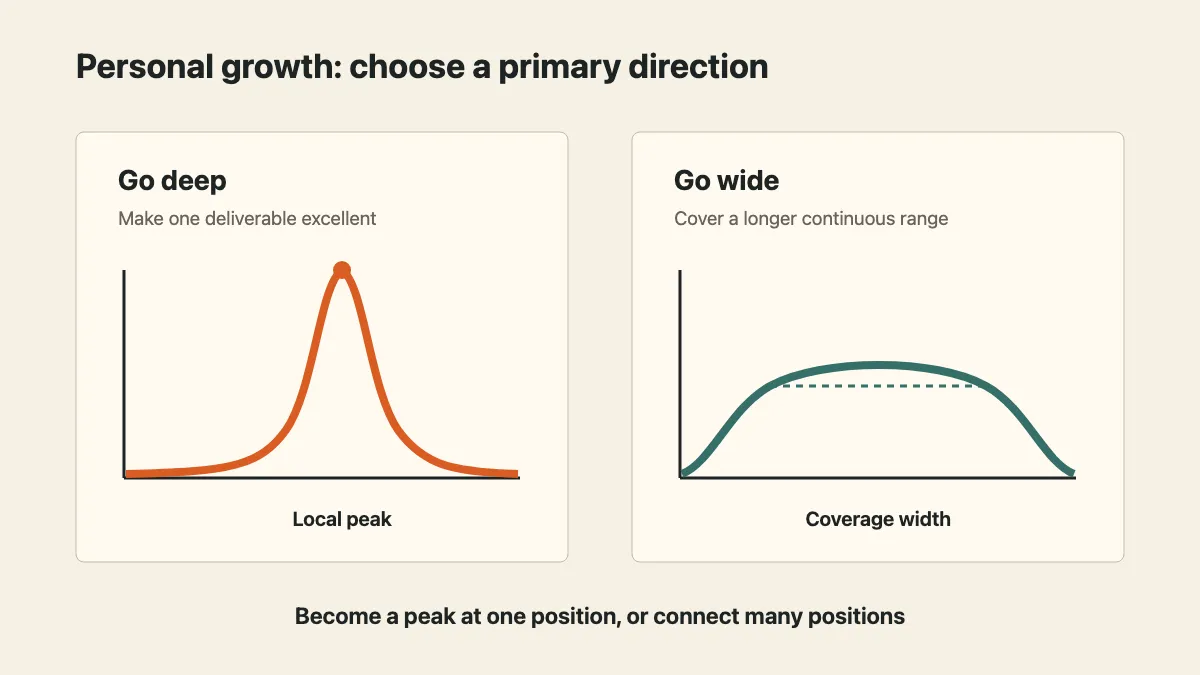
One direction raises the peak. The other widens the range.
I do not like using “T-shaped people” as a safe answer that blends these two directions back together. Time is limited. At any stage of a career, one direction needs to take priority: raise the peak of your ability, or widen the range you can cover. AI makes widening easier, while making depth that cannot be replaced by general capability more valuable.
The uncomfortable position is a narrow range without exceptional depth. Such a person neither sets the ceiling for a deliverable nor fills gaps, creates overlap, or carries work across the spectrum. In the AI era, the choice is becoming more direct: become the peak at one position, or expand the range you can cover continuously.